
Siri AI is live, in English, on half your users' phones
The rebuilt Siri shipped as a beta with a long list of exclusions. Read that list before you promise a client a voice-driven feature this year.
On 14 September Apple began rolling out the rebuilt Siri as a beta across iOS 27, iPadOS 27, macOS 27, watchOS 27 and visionOS 27. It can draw on personal context from messages, emails and photos, understand what is on screen, answer from the web, and trigger actions inside third-party apps.
That is the headline. The part worth your attention is the availability list underneath it, because it decides whether any of this is something you can actually build a client feature on this year.
Read the exclusions as a product constraint
Siri AI launched in English only, with French, Japanese, Korean, Portuguese and Spanish stated for October. It is unavailable in the European Union at launch, unavailable in China pending regulatory approval, and unavailable to users under thirteen. Server-backed requests carry daily usage limits, and Apple has said paid access is coming.
Stack those together and the addressable audience for a Siri-driven feature on day one is a specific slice of your users: English-speaking, over thirteen, outside the EU and China, on an Apple Intelligence capable device.
For a studio in Surat shipping to clients with users across India, the Gulf and Europe, that slice is frequently the minority. We have quoted work this month where the honest answer was that fewer than half the target users would see the feature at all in the first six months.
The hardware floor is higher than people assume
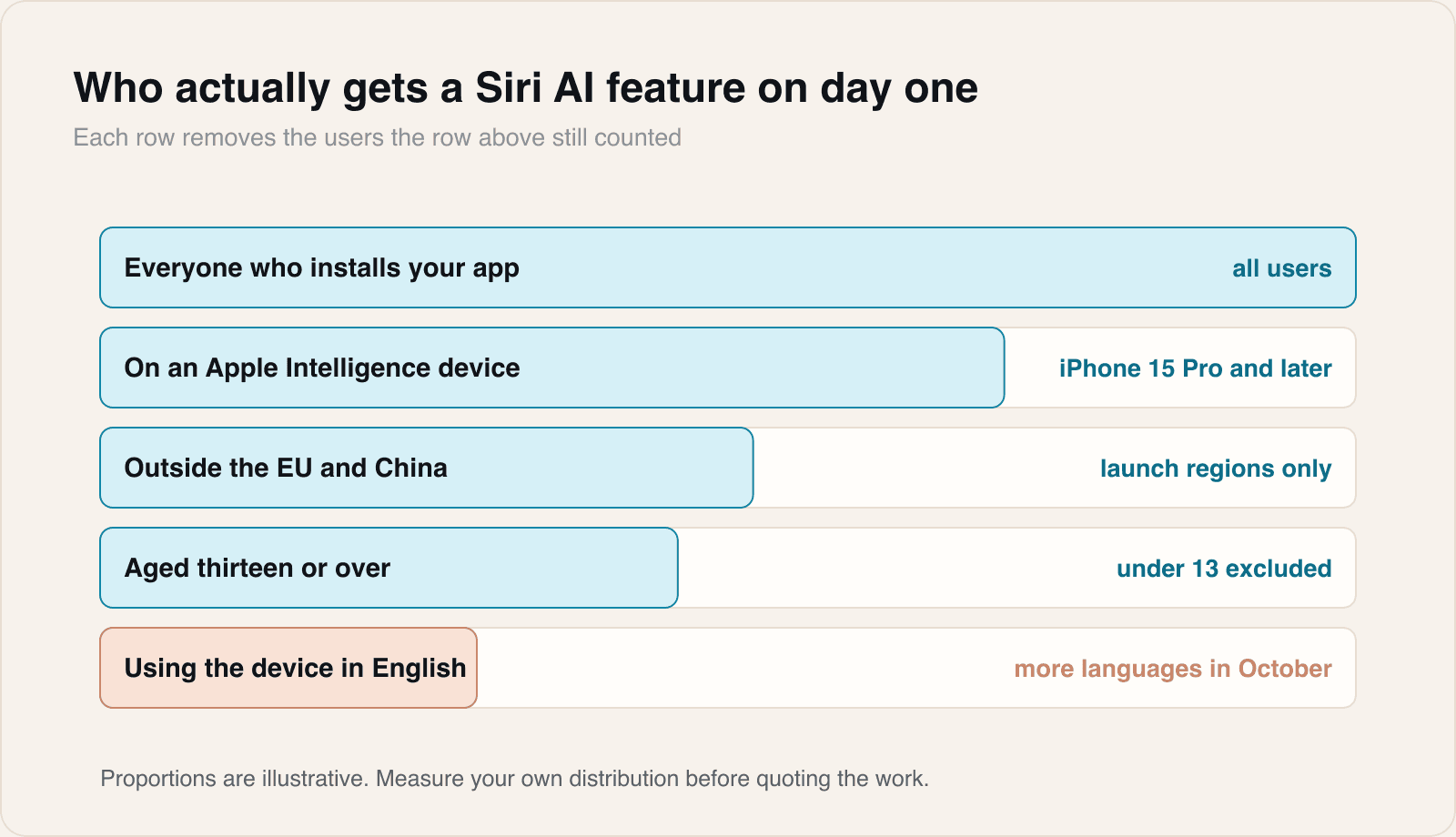
Apple Intelligence needs an iPhone 15 Pro or later, an iPad with M1 or an iPad mini with A17 Pro, a Mac with M1 or the MacBook Neo, Apple Watch Series 9 or Ultra 2 and later, or Vision Pro.
Note what is missing from that list: every non-Pro iPhone before the 16. A large installed base of perfectly current phones cannot run any of this. If your analytics show a long tail of iPhone 14 and 13 users, that tail is entirely excluded, and it will be excluded for years.
How to build against it anyway
None of this means ignore it. It means the order of work changes. Build the feature so it works without Siri, then let Siri drive it where available.
- Design the tappable path first and ship it. It is the path every user gets, and it is the one that has to be good.
- Expose the same operations through App Intents. Siri app actions, Shortcuts, Spotlight and the Action button all draw from the same definitions, so the work pays for itself even where Siri AI is absent.
- Check capability at runtime and degrade silently. A voice affordance that appears and then fails is worse than one that never appeared.
- Never let a server-backed assistant call sit on the critical path of a task. Daily limits mean it can fail on a perfectly healthy device.
An assistant integration should be an accelerator, never a dependency.
What we tell clients
That a Siri feature is worth building when the underlying action is worth building on its own merits. App Intents are cheap to add once the action exists, they improve discoverability through Spotlight and Shortcuts regardless of Siri, and they position the app for the day the availability list gets shorter.
What is not worth doing is designing a flow whose primary route is voice, on a platform where a majority of the target audience currently has no access to it. That is a demo, and it will be sold as a product until the first support ticket arrives.
Sources
 Apple Launches Siri AI Beta With Personal Context, Onscreen Awareness, and App ActionsiClarified, 2026-09-14
 Apple Officially Releases iOS 27 and iPadOS 27iClarified, 2026-09-14
Reporting and images linked above belong to their respective publishers and are shown from their own servers. The analysis here is our own.