
Apple's three iOS 27 speed numbers each come from a different iPhone
Apple says iOS 27 launches apps 30 per cent faster and moves AirDrop 80 per cent faster. The footnotes name three different iPhones and three different tests.
Apple has published three headline performance figures for iOS 27, and a footnote for each describing how it was measured.
The claims appear on Apple's iOS 27 page and in the release that accompanied the software on 14 September: apps launch up to 30 per cent faster, newly taken photos load in the Photos library up to 70 per cent faster, and AirDrop transfers are up to 80 per cent faster. Apple's own support note about iOS 27 compresses all three into a single bullet without numbers. 9to5Mac assembled the longer version, more than thirty individually named improvements, from Photos and Safari through HomeKit pairing, PDF saving, Voice Control response and Assistive Access.
The footnotes are where the detail is. The 30 per cent app launch figure was measured by Apple in August 2026 on an iPhone 11 Pro Max, comparing iOS 26.6 with a prerelease iOS 27, with launch performance measured after many cycles of device usage. The 70 per cent photo figure comes from July 2026 on an iPhone 15, with a Photos library of 50,000 assets. The 80 per cent AirDrop figure comes from July 2026 on an iPhone 16 Plus, transferring multiple photos totalling 30MB between nearby contacts while not associated with a Wi-Fi network. A fourth footnote covers the iPad claim of up to five times faster external drive browsing, measured on an 11-inch iPad Pro with M4 and an APFS-formatted USB 4 SSD.
What the footnotes cover
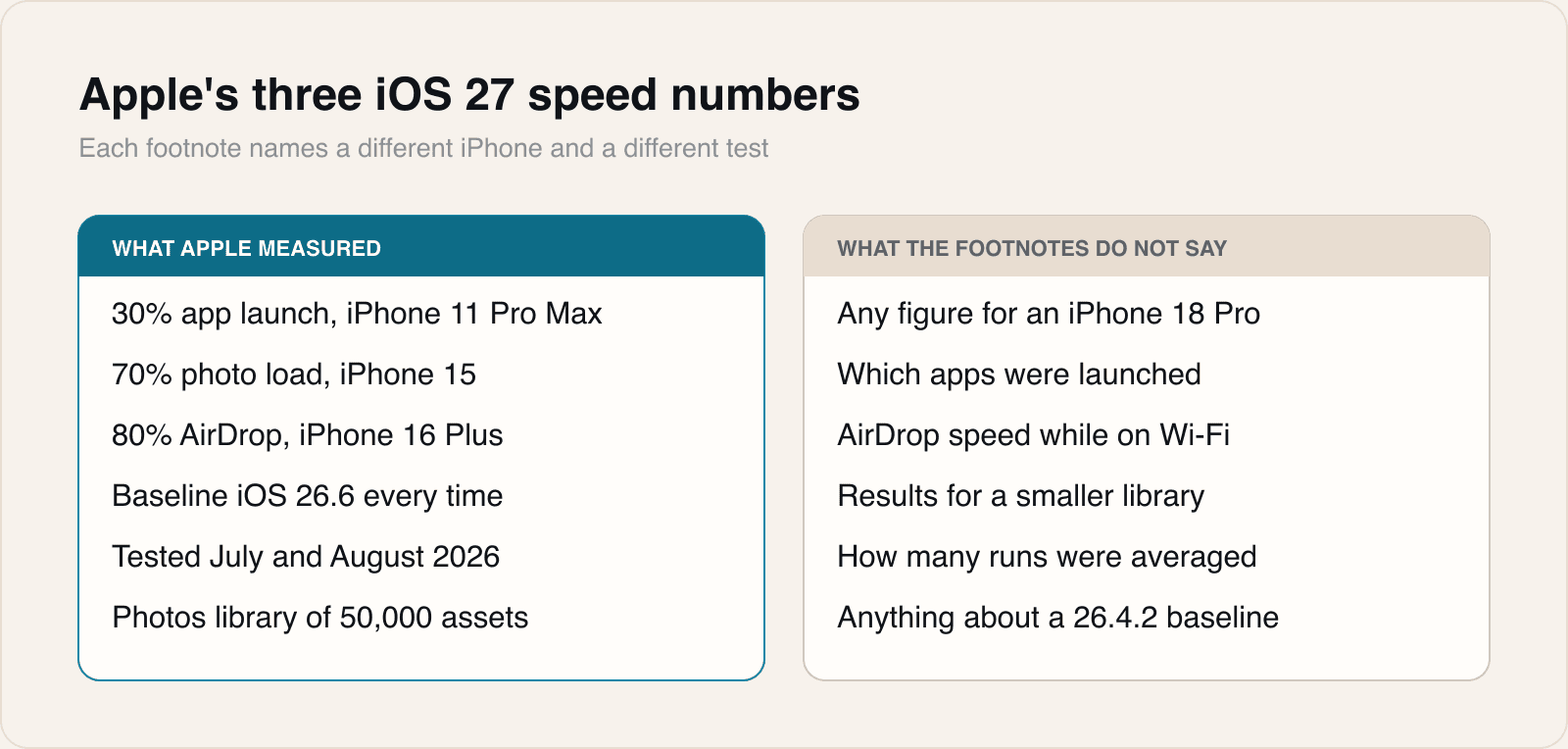
One number is worth flagging because the sources disagree. MacRumors, writing in July, reported that Apple's footnote then named iOS 26.4.2 as the baseline for the app launch test. The footnote Apple publishes today names iOS 26.6 and dates the test to August 2026. We have used the current wording, because it is the one attached to the shipping claim. The headline figure did not change when the baseline did.
MacRumors also reported, from Apple's June announcement, mechanisms rather than percentages: an optimised CPU scheduler extended back to the iPhone 11, a rebuilt search index shared by Spotlight, Photos and Mail, improved Bluetooth power management, and automatic resending of failed iMessages. Those are the parts of the work that have no number attached, and they are the parts most likely to be felt.
Our take
The choice of an iPhone 11 Pro Max for the headline figure is the most interesting thing in these footnotes, and we read it as deliberate and to Apple's credit. iOS 27 runs on the iPhone 11 and later. A 30 per cent improvement on a phone from 2019, measured after many cycles of use rather than on a freshly wiped device, is a claim about the worst case rather than the best one. A vendor optimising for a good headline would have used the newest hardware and a clean install.
It does mean the number does not transfer. Nothing in Apple's material says what an iPhone 18 Pro gains, and there is a structural reason to expect less: app launch on recent hardware was already fast enough that the remaining time is mostly work the app itself is doing. If you own a current phone, the figure to watch is not 30 per cent, it is whichever of the thirty-odd named items happens to sit on your daily path. Faster emoji keyboard loading and faster entry into Guided Access are small, unglamorous and far more likely to be noticed than a percentage.
The conditions on the AirDrop claim reward a careful reader. Up to 80 per cent faster was measured while the phone was not associated with a Wi-Fi network, which is the scenario where AirDrop has the radio to itself. In a busy office on congested Wi-Fi, the number that matters is one Apple has not published. That is not a trick, it is how vendor benchmarks have always worked, and it is exactly why the footnote is the part worth reading.
For anyone shipping an app, there are two things to take from this and one to resist. Take the fact that the floor has moved: the slowest device your users have is faster this month than it was last month, which changes what is defensible in a launch path. Take the rebuilt search index seriously, because an app contributing to Spotlight is now competing in a ranking rather than a list. Resist the temptation to attribute your own improved launch numbers to iOS 27 without checking. Apple has just made the baseline move underneath every measurement you took before September, and a regression hiding behind a platform gain is the kind of thing nobody finds until the next release takes the gain back.
Sources
 Major updates for Apple's software platforms are now availableApple Newsroom, 2026-09-14
 iOS 27Apple, 2026-09-14
- About iOS 27 UpdatesApple Support, 2026-09-14
 iOS 27 makes your iPhone faster in these 30+ ways9to5Mac, 2026-09-20
 10 iOS 27 Performance Improvements You'll Actually NoticeMacRumors, 2026-07-23
Reporting and images linked above belong to their respective publishers and are shown from their own servers. The analysis here is our own.