
Apple Intelligence now wants 14GB free on the newest iPhones, and Apple's own pages disagree on which those are
Apple's updated support document says iOS 27 needs up to 14GB of free storage for Apple Intelligence on some iPhones, against 8GB on the rest of the range.
Apple's support document on Apple Intelligence now states that iOS 27 requires up to 14GB of free on-device storage on some iPhones, against up to 8GB on the rest of the supported range.
The document, titled How to get the next generation of Apple Intelligence, lists the higher figure for the iPhone 17 Pro, iPhone 17 Pro Max and iPhone Air, for iPad models with an M4 chip or later and at least 12GB of unified memory, for Macs with an M3 or later and at least 12GB of unified memory, and for Apple Vision Pro with an M5. Every other Apple Intelligence device is listed at up to 8GB. Apple Watch is listed separately at up to 1.5GB. 9to5Mac reported the change on Friday and attributed the split to two features: customisation of Siri's expressivity and pace, and improved dictation accuracy.
That attribution matches what Apple said in its Siri AI newsroom post on 14 September, which describes dictation as capturing speech, in Apple's words, as polished text with greater precision, and ties expressive voices and more advanced dictation to the company's most powerful on-device model. The storage difference is the model, not the features layered on it.
Two Apple pages, two device lists
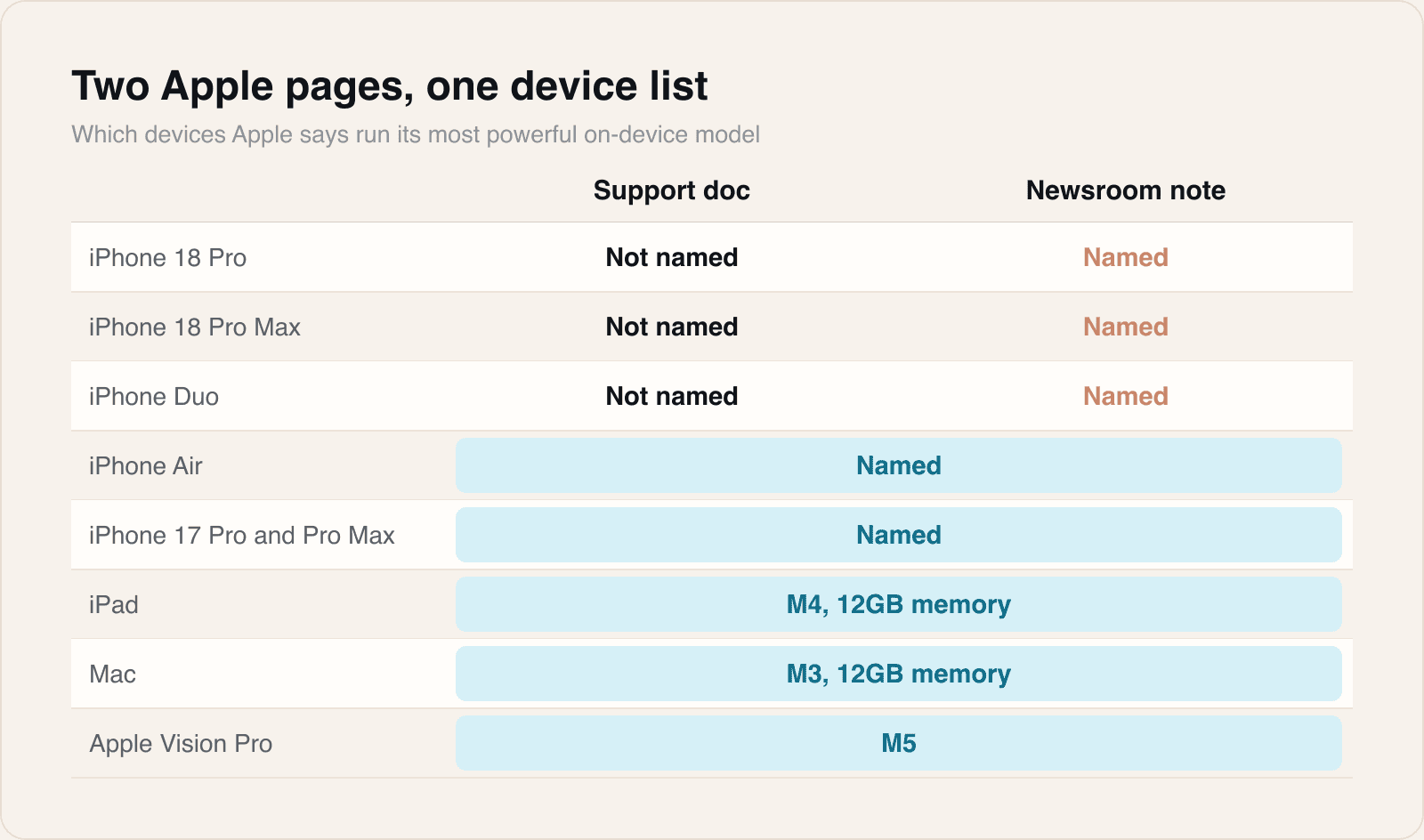
The two documents do not name the same devices. The newsroom footnote from 14 September lists the most powerful on-device model as available on iPhone Duo, iPhone 18 Pro, iPhone 18 Pro Max, iPhone Air, iPhone 17 Pro, iPhone 17 Pro Max, iPad with M4 or later and 12GB of unified memory, and Mac with M3 or later and 12GB of unified memory, with Apple Vision Pro on M5 added for the model and expressive voices. The support document's storage section names neither the iPhone 18 Pro, nor the iPhone 18 Pro Max, nor the iPhone Duo.
We are not reading that as an exclusion. The iPhone 18 Pro went on sale on 18 September and the iPhone Duo does not arrive until 23 October, and the far likelier explanation is a support page that has not caught up with a newsroom footnote. But it is Apple's own storage page, it is the one a user is sent to, and on the day the phone reached shops it did not mention the phone.
What it means
For most people this is a number that will never be noticed. Fourteen gigabytes sounds large next to eight, and it is small next to the 256GB that is now the floor on a Pro iPhone. The people it reaches are the ones it always reaches: anyone still living on a 128GB device, anyone who keeps a phone until the storage warning becomes a permanent fixture. The awkward part is that they are disproportionately the people on older hardware, which is the hardware Apple says needs only 8GB.
The phrasing deserves attention, because Apple chose it carefully. The document says up to 14GB, not 14GB. Apple Intelligence downloads models on demand rather than shipping the full set with the OS, so the number is a ceiling for a device that eventually pulls everything down rather than a fixed reservation taken on upgrade. That also means the failure mode is quiet. A feature does not announce that it is unavailable for want of space; it just does not appear, and nothing tells you why.
There is a second reading, and it is the one we find more interesting. The 14GB tier is not defined by how new a device is. It is defined by memory: 12GB of unified memory on iPad and Mac, and on the iPhone side a list that happens to be the phones with the most of it. Apple has spent two years describing Apple Intelligence as one feature set that scales across the line. This is the first requirement page where the line is drawn by how much RAM the silicon carries, and a user reading it learns that two iPhones running the same iOS 27 are running different models underneath.
For anyone making apps that call Apple's on-device models, the practical consequence is that device support and feature support have quietly separated. A device can be Apple Intelligence enabled, be running iOS 27, be in a supported language and region, and still not have the model behind expressive voices or the better dictation, either because it is the 8GB tier or because it is the 14GB tier with 6GB free. Neither of those is a capability you can infer from an OS version check.
Sources
- How to get the next generation of Apple IntelligenceApple Support, 2026-09-18
 Apple Intelligence now requires almost double the iPhone storage on latest models9to5Mac, 2026-09-18
 Siri AI, a profoundly more capable and personal assistant, is hereApple Newsroom, 2026-09-14
Reporting and images linked above belong to their respective publishers and are shown from their own servers. The analysis here is our own.