
If your app has an AI chat feature, the EU Kids Act now reaches it
Von der Leyen's speech put games, AI chatbots and app stores inside the Kids Act. An assistant bolted onto a consumer app is now a regulated surface.
In her State of the Union address on 16 September, Commission President Ursula von der Leyen announced the EU Kids Act. The text is due to be presented on 18 September. We wrote about the addictive-design side of it this morning; the speech added scope that the earlier reporting did not have, and the new scope is the part that reaches ordinary apps.
It is not limited to social networks. Reporting across CNN, Bloomberg and Agence Europe puts video-sharing platforms, online games, and AI chatbots and companions inside it, with age checks extending to app stores.
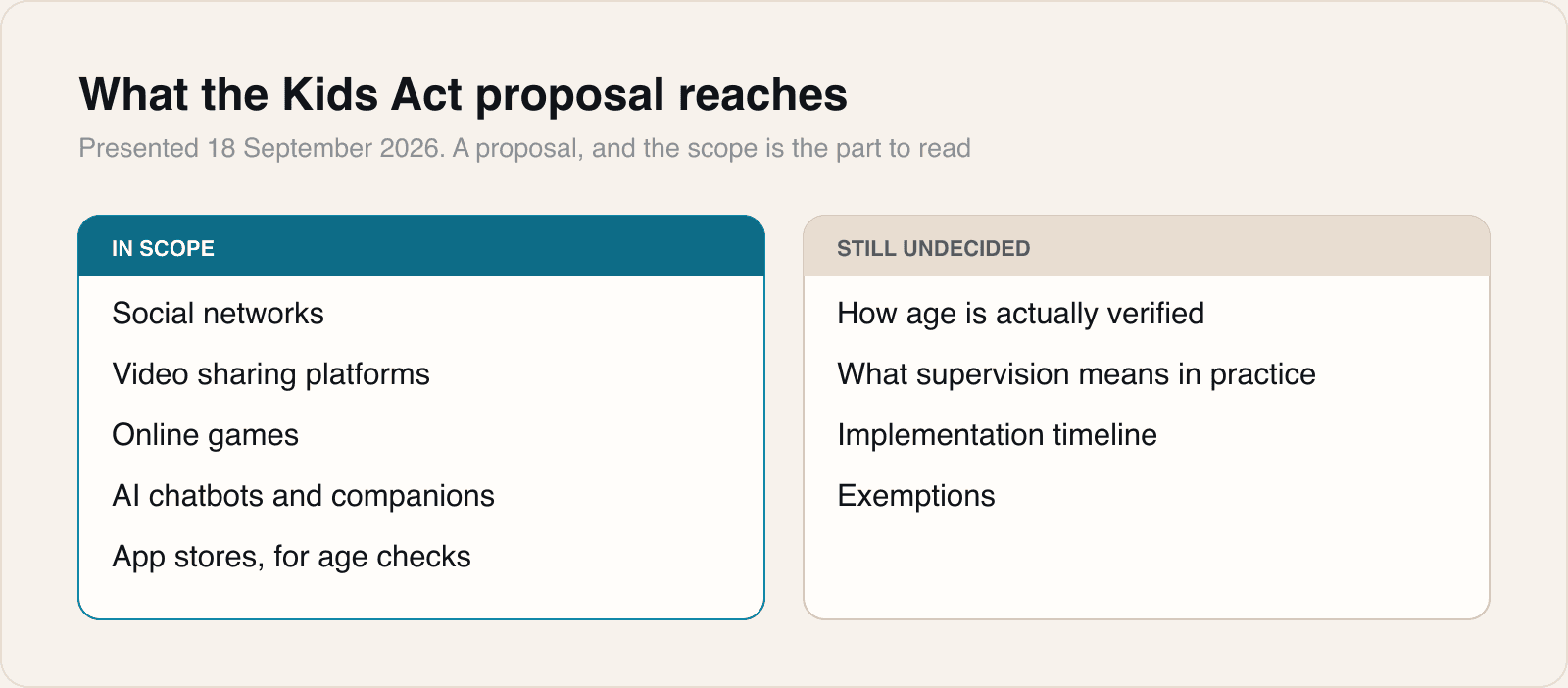
A correction to what we published this morning
Our earlier piece described the thirteen to fifteen tier as access with parental consent and controls, following MacRumors. The wider reporting is more specific and more restrictive: no personal account under fifteen, and only a supervised account with restricted features and a one hour daily limit.
We are flagging that rather than quietly editing it, because the difference is the difference between a settings screen and a different product. Where two sources disagree on a proposal this young, the more specific and more widely corroborated one is the one to plan against.
The assistant you added last year is a regulated surface
A great many consumer apps acquired an AI chat feature in the last eighteen months. In most cases it was scoped as a feature, not as a category of product, and nobody wrote down what happens if a minor uses it.
The proposal reportedly requires services offering chatbots and companions to avoid designs that encourage unhealthy emotional attachment or expose minors to harmful interactions. That is a design obligation rather than a data one, and design obligations cannot be met by a policy document.
- Know whether minors can reach your assistant at all. For most apps nobody has asked.
- Separate the assistant's availability from the rest of the app, so it can be withheld by age without withholding the product.
- Look hard at anything that simulates a relationship: persistent memory of the user, a persona, encouragement to return. Those are the patterns named.
- Write down what the assistant must refuse. A model that will discuss anything is not a feature on a minor's account.
The burden of proof is the structural change
The detail that will outlast the headlines is that platforms would have to demonstrate their service is safe for minors, rather than a regulator having to demonstrate it is not.
A duty to prove safety is a duty to have written something down.
That converts a lot of implicit design judgement into documentation. If a reviewer asks how you concluded a feature is appropriate for a fourteen year old, the answer has to exist before the question, and a team that has never considered the question cannot produce one afterwards.
What we would do now, and what we would not
It is a proposal. It has not been presented, let alone passed, and the detail will move. The reasonable response is not compliance work; it is knowing where you stand if it arrives roughly as described.
Fines are reported at up to six percent of global annual revenue, which is the number that will get the attention of any client with European users. For a studio the useful contribution is not alarm. It is being able to answer, in one page, which of a client's surfaces a minor can reach and what each one does.
Sources
 EU's Kids Act to Ban Social Media for Under-13s, Curb Chatbot AccessMacRumors, 2026-09-16
 EU announces plan to ban social media for under 13sCNN, 2026-09-16
Reporting and images linked above belong to their respective publishers and are shown from their own servers. The analysis here is our own.