
GymKit now runs from an iPhone, with AirPods Pro 3 supplying the heart rate
GymKit, the treadmill pairing feature Apple Watch has had since 2017, now works from an iPhone in iOS 27, with AirPods Pro 3 as the heart rate source.
Apple has extended GymKit, the system that pairs an Apple device with cardio machines in a gym, to the iPhone in iOS 27.
GymKit launched in 2017 and had been an Apple Watch feature only. MacRumors reported the expansion when Apple announced it in June, describing a two-way exchange in which the device supplies heart rate and the machine returns speed, pace, distance and calories. Apple's own note on the September release is one line in a list of platform changes, and it names the missing piece: with the expanded GymKit, people using AirPods Pro 3 can sync heart rate data through an iPhone. AirPods Pro 3 are the only AirPods with a heart rate sensor.
Apple's iPhone user guide gives the mechanics. The compatible equipment is described as treadmills, ellipticals, indoor bikes and more. GymKit is switched on in the Fitness app, by tapping Summary, then your picture or initials, then GymKit, then Detect Gym Equipment. From there you hold the iPhone within a few centimetres of the contactless reader on the machine, tap Continue, choose the workout and press Start on the equipment itself. There is a second route through Fitness, Workout, then GymKit at the bottom of the list. A workout is ended from the Fitness app rather than from the machine.
Where the heart rate comes from
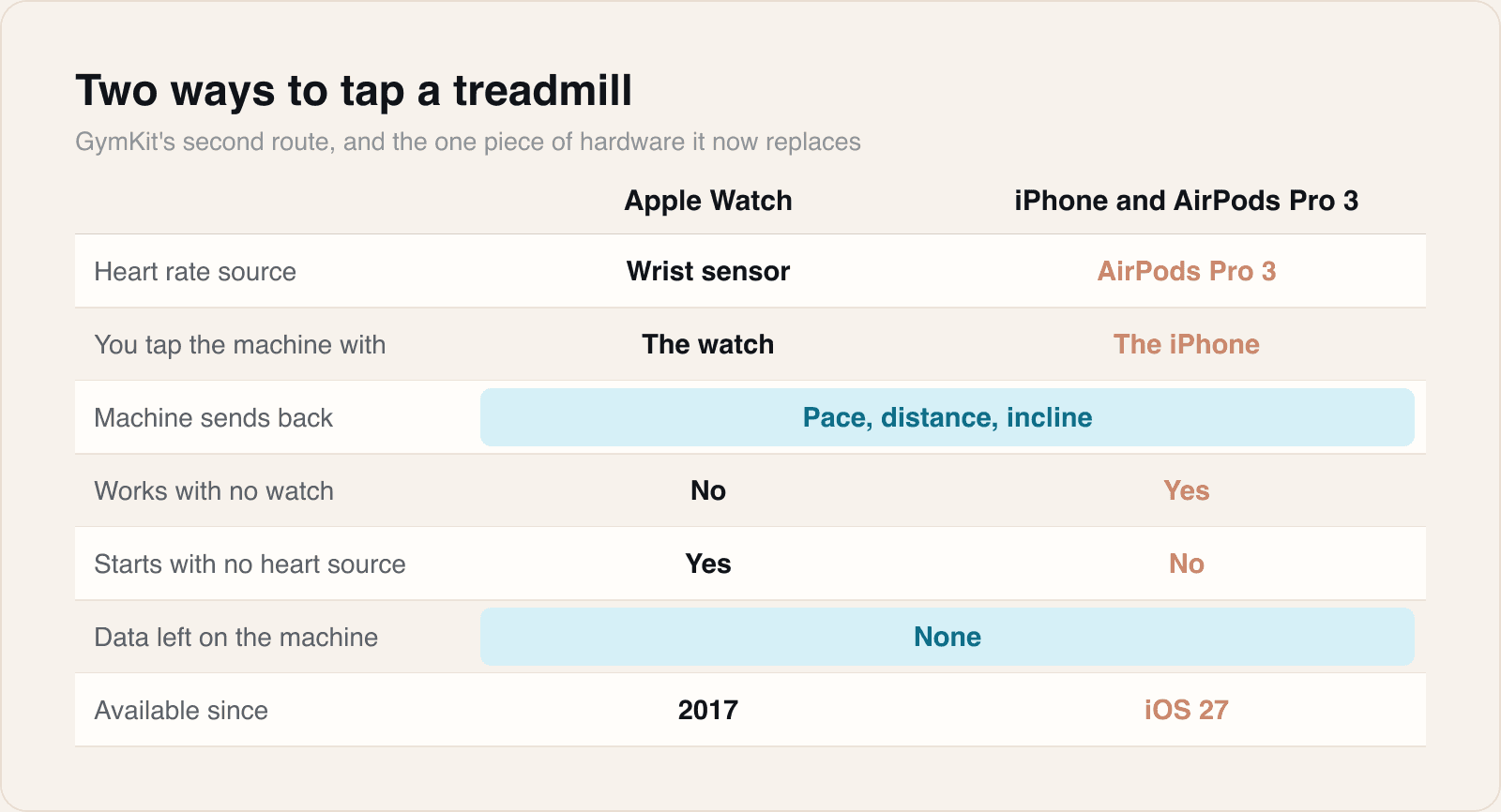
9to5Mac tested the arrangement on a GymKit treadmill before the release. Its account describes tapping the iPhone to the machine, choosing Indoor Walk, and starting from the treadmill, after which the machine received heart rate from the AirPods while the Fitness app received distance, pace, incline and calorie data back. Two failure modes are worth knowing. Starting a GymKit workout from an iPhone with no AirPods in caused the connection to drop at the start of the workout, because nothing was supplying heart rate. Starting one while wearing an Apple Watch pushed the user back towards the watch's Workout app instead.
The heart rate sensor in AirPods Pro 3 is a permission rather than a given. Apple's AirPods guide puts the switch in Settings, under the name of the AirPods, as Heart Rate, and notes it may sit behind Privacy. Anyone who turned it off will find GymKit on iPhone does not work until it goes back on.
What Apple's documents do not say is as useful. The iPhone user guide page for GymKit never mentions AirPods Pro 3, heart rate or the fact that a heart rate source is required at all. The requirement appears in the newsroom release and in the AirPods documentation, and not in the page a user would actually read while standing in front of a treadmill.
Our take
This is Apple unbundling the Apple Watch, and doing it with more care than the headline suggests. GymKit was one of the quieter arguments for wearing a watch in a gym: it is the only way to make a treadmill's belt distance and incline agree with what your own device thinks happened. Handing that to an iPhone and a pair of earbuds removes a reason to buy a watch, which is not a thing Apple normally does by accident.
The likely reasoning is that the chain is longer, not shorter. To use GymKit without a watch you need an iPhone, AirPods Pro 3, a GymKit machine in front of you, and a permission you may have switched off. That is a narrower set of people than it first appears, and 9to5Mac's framing of it as a backup for a flat or forgotten watch reads right to us. The strategic value is different: it lets someone experience the thing the watch is good at before they own one.
For gym operators the arithmetic changed more than it did for anyone else. A GymKit treadmill is a capital purchase that has been justified for eight years on the proportion of members wearing an Apple Watch. That proportion is now the wrong number, because the qualifying population includes every member with an iPhone and heart rate earbuds. Nobody has published what that does to the business case, and we would expect equipment makers rather than Apple to be the first to say.
For anyone building a fitness app, the practical point is that GymKit is not an API you can call. Apple runs it as a hardware programme for equipment manufacturers through MFi, and publishes no app-facing GymKit framework. What an app sees is the result: a workout written by Fitness, readable through HealthKit with the user's permission, carrying machine-derived distance and incline that no phone in a pocket could have measured. If your app reads workouts, it is about to start seeing indoor sessions with unusually good metrics attached and no Apple Watch anywhere in the record. Treat the source of those numbers as unknown rather than assuming a wrist.
Sources
 Major updates for Apple's software platforms are now availableApple Newsroom, 2026-09-14
- Use gym equipment in Fitness on iPhoneApple Support, 2026-09-14
- Track your heart rate during workouts with AirPods Pro 3Apple Support, 2026-09-14
 Apple Expands GymKit to iPhone and AirPods Pro 3MacRumors, 2026-06-09
 iOS 27 basically turns your iPhone and AirPods into an Apple Watch at the gym9to5Mac, 2026-09-02
 AirPods Pro 3 keep getting better, here's what's new in iOS 279to5Mac, 2026-09-18
Reporting and images linked above belong to their respective publishers and are shown from their own servers. The analysis here is our own.