
The iPhone 18 Pro Max needs Prepare to Ship before you post it, and its battery is why
Apple published a support document on 18 September describing Prepare to Ship, an iPhone 18 Pro Max setting that discharges the battery before the phone is posted.
Apple published a support document on Friday 18 September describing Prepare to Ship, a setting on the iPhone 18 Pro Max that discharges the battery before the phone is sent anywhere.
The reason is a single number. Apple states that the iPhone 18 Pro Max battery capacity is above 20 watt-hours, and that a device with a single-cell battery over that figure carries additional shipping requirements in most countries and regions. To meet them, the phone leaves the factory with a firmware limit holding its usable capacity below 20 Wh, and that limit is removed when the phone is activated. A sealed, unactivated iPhone is therefore already compliant and needs nothing done to it. Apple nowhere publishes the battery's actual watt-hour rating; its specifications page quotes battery life in hours of video playback, up to 45 on the Pro Max, and no capacity figure at all.
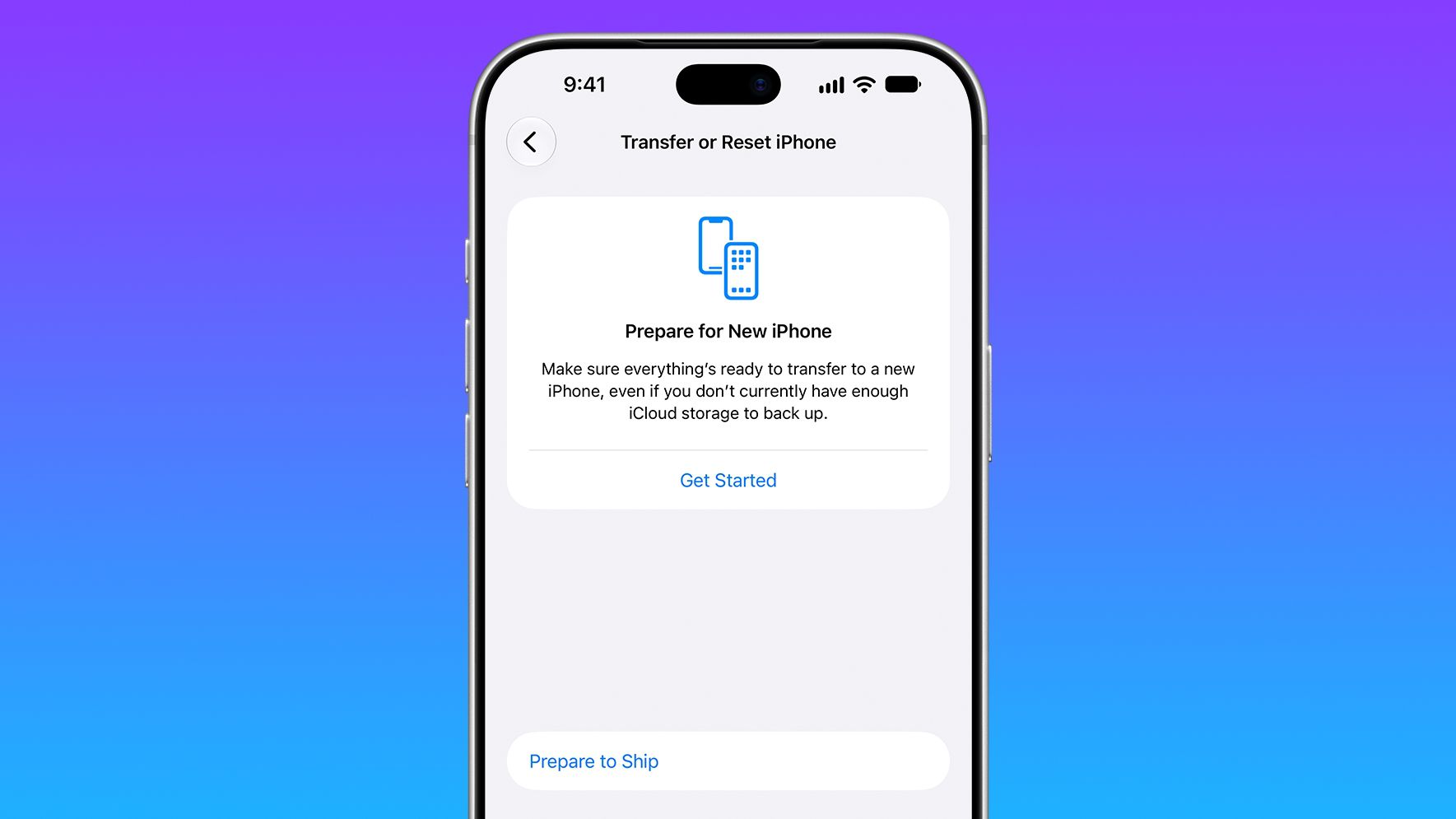
The feature lives at Settings, then General, then Transfer or Reset iPhone, then Prepare to Ship, and it needs a Wi-Fi or cellular connection. Apple advises disconnecting the charger first, because that speeds the discharge up. How long it takes depends on where the battery starts: Apple says a few minutes is common, and a phone at a full charge can take up to a couple of hours. The device may become warmer than usual while it drains, which Apple describes as expected, and it stays usable throughout unless the owner chooses to erase it. When the process finishes, Settings shows Ready to Ship with a red badge. On an erased handset the same status appears on the Hello screen behind the Info button.
The two reasons you can give
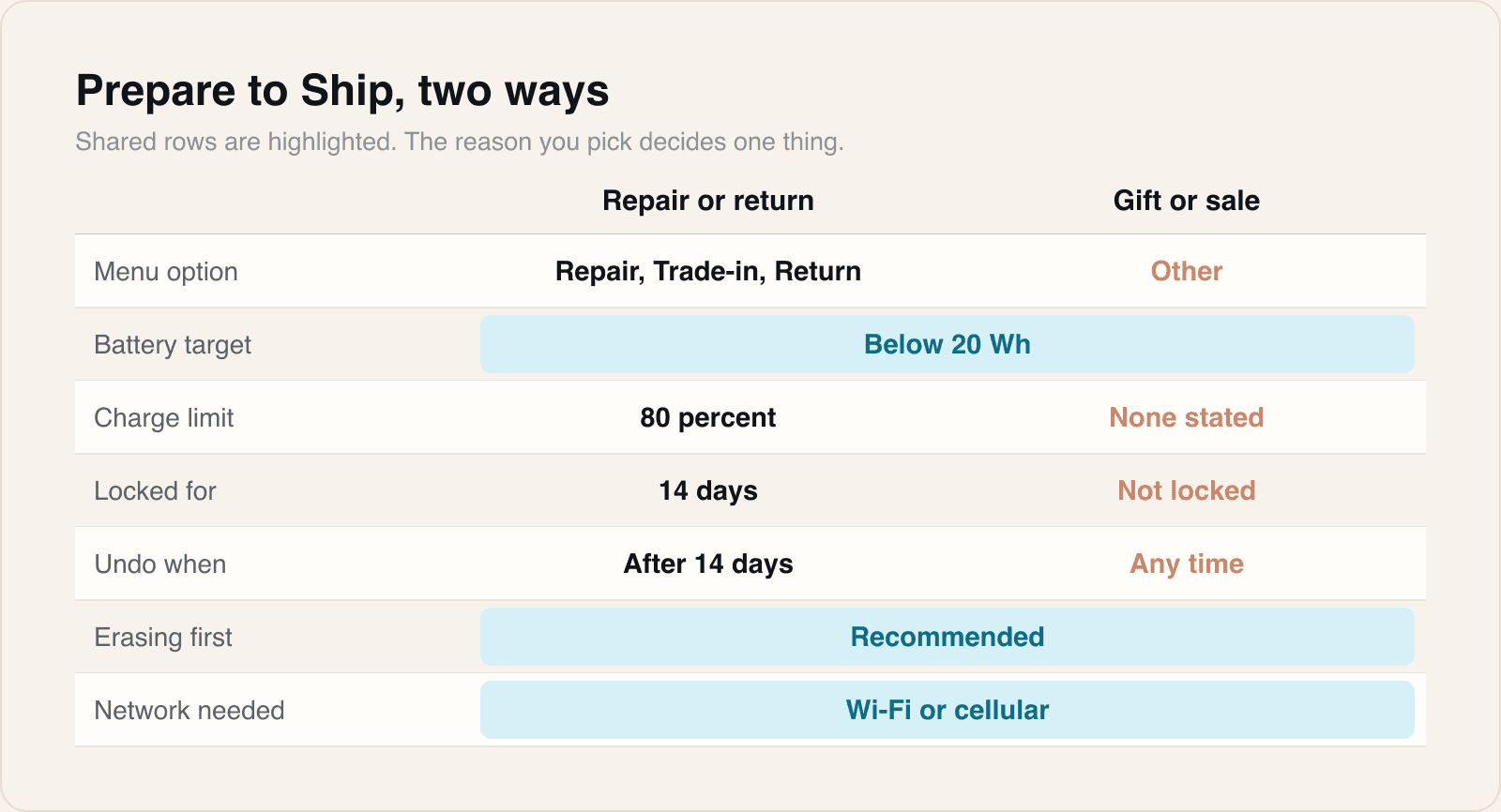
Apple asks what the phone is being sent for, and the answer changes what happens afterwards. Choosing Repair, Trade-in, or Return caps the charge limit at 80 per cent for 14 days, which Apple says is what keeps the battery below the 20 Wh threshold in transit, and Prepare to Ship cannot be switched off until those 14 days have passed. Choosing Other, the option Apple offers for giving or selling a phone to an individual, can be reversed at any moment from the same screen. MacRumors, reporting the document on Friday evening, noted the waiting period and tied it to the reason selected.
The repair path has two further steps. Apple tells owners to contact the recipient first, because companies often have their own procedure to complete beforehand, and warns that if the Ready to Ship screen never appears the phone should not be posted at all, since it will probably need specific packaging. Activation Lock has to be removed for a return or a trade-in. Erasing the device is recommended but, in Apple's wording, not required.
The rule behind 20 watt-hours
Apple names no regulation, but the threshold it quotes is not an arbitrary one. A phone travelling by air is carried under UN 3481, lithium-ion batteries contained in equipment, and Packing Instruction 967. IATA's 2026 guidance document for lithium batteries splits that instruction at precisely the figure Apple cites: cells at or below 20 Wh fall into Section II, while cells above 20 Wh fall into Section I, which brings UN specification packaging, a five kilogram per package limit on passenger aircraft and the fully regulated handling, marking and documentation that goes with a dangerous goods consignment. The same document separately recommends, without making it mandatory, that equipment containing lithium cells travel at a state of charge no higher than 30 per cent, or an indicated capacity no higher than 25 per cent.
Those are two different mechanisms and it is worth keeping them apart. Apple's 80 per cent cap is not the state of charge recommendation. It is arithmetic against the watt-hour ceiling, holding a battery whose full capacity is above 20 Wh at a level where the figure that counts sits underneath it.
What Apple does not say is as clear as what it does. The document gives no capacity figure, names no regulator, and does not state what happens to a phone posted without the step. It says only that the battery is safe, including for shipping and air travel, that the process exists to meet shipping requirements, and that it is needed neither while travelling with the phone nor on any other iPhone model.
Our take
The genuinely new thing here is not a battery that got bigger. It is a shipping regulation being satisfied in firmware. Historically a watt-hour threshold was a packaging and paperwork problem, solved by the shipper with a label, a box and a training record. Apple has moved it inside the device, so that the phone itself decides whether it is currently legal to fly as ordinary cargo and reports that state on its own lock screen. That is a quietly significant reframing of what a product specification is, and we expect to see it copied rather than reversed.
The part that will generate support calls is the 14 days. It is a deliberate lock, not a cooling-off period, and it catches a perfectly ordinary situation: someone starts a trade-in, changes their mind, cancels it, and then owns a phone that will not charge past 80 per cent for a fortnight with no way to hurry it along. Apple's document is candid about this and buries it under a heading about undoing the feature, which is exactly where a person in that position will not think to look. The fix is one line of on-screen warning at the moment the reason is chosen, and Apple has not written it.
For independent repairers the effect is subtler and probably more lasting. A repair shop taking in an iPhone 18 Pro Max for onward shipment now depends on a software state it cannot verify from the outside, cannot set without the owner's Apple Account password, and cannot set at all if the screen is broken, which is the single most common reason a phone gets shipped for repair in the first place. Apple's answer to a dead screen is to contact Apple or the recipient before posting. That is a workable instruction for Apple's own logistics chain and a materially worse one for everybody else's, and it arrives in the same year that several jurisdictions have been legislating to make independent repair easier.
The wider point is that this will not stay a single-model curiosity. The 20 Wh line is fixed and battery capacities are not, so every generation that buys more endurance by adding cell capacity walks closer to it. The iPhone 18 Pro Max is the first Apple phone to cross, which makes Prepare to Ship the template rather than the exception. Anyone running a fleet, a trade-in programme or a device recycling operation should treat this as the first of several and work out now whose job it is to press the button, because the alternative is discovering the answer when a pallet gets refused.
Sources
- Prepare your iPhone 18 Pro Max to shipApple Support, 2026-09-18
 iPhone 18 Pro Max Requires Prepare to Ship Battery Drain Before ShippingMacRumors, 2026-09-18
 IATA Guidance Document for Lithium Batteries and Sodium ion Batteries 2026IATA, 2026-01-01
 iPhone 18 Pro and iPhone 18 Pro Max Technical SpecificationsApple, 2026-09-09
Reporting and images linked above belong to their respective publishers and are shown from their own servers. The analysis here is our own.