Apple's 250 million dollar Siri settlement is taking claims, and the window shuts on 21 December
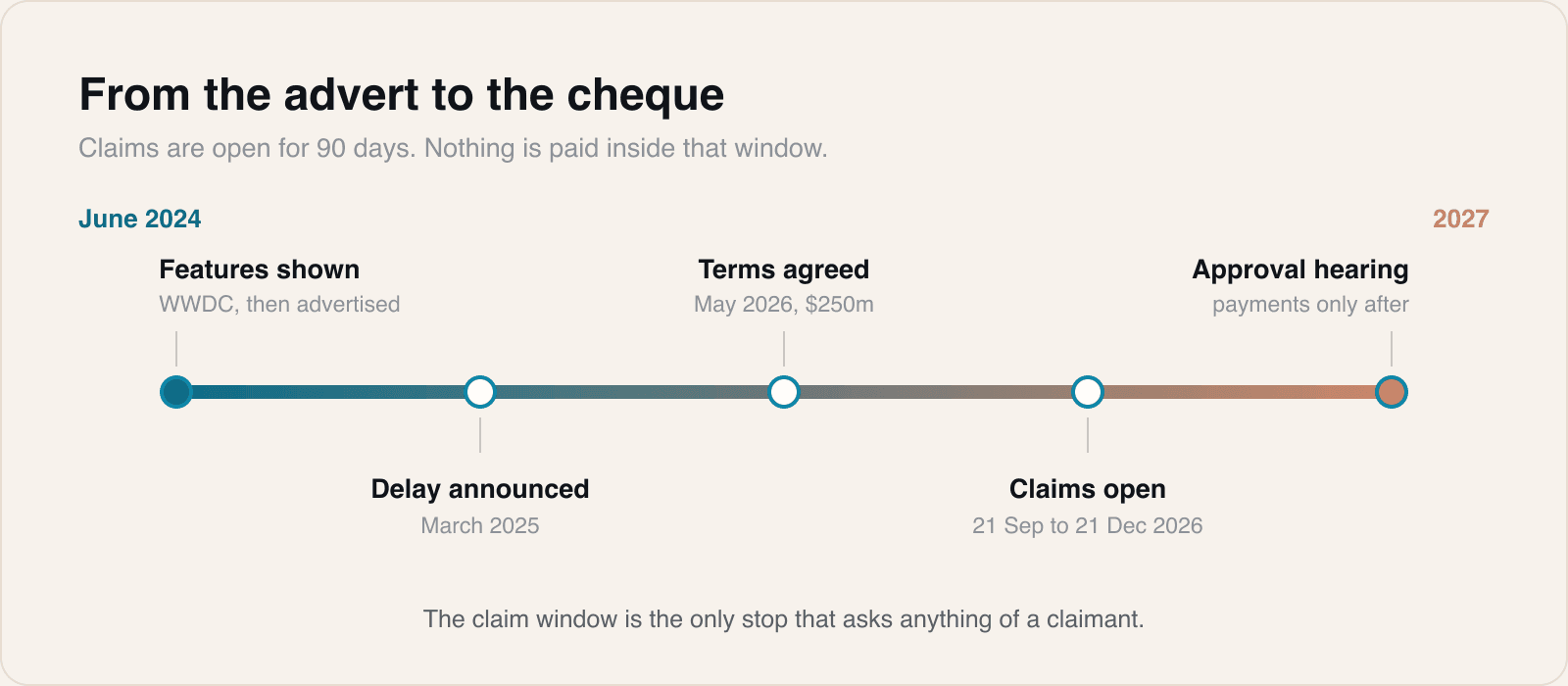
The claims site for Apple's 250 million dollar Siri settlement is live, opening a 90 day window for United States buyers of certain iPhone 15 and 16 models.
The claims website for Apple's 250 million dollar Siri settlement went live on 20 September 2026, ahead of a filing window that runs from 21 September to 21 December.
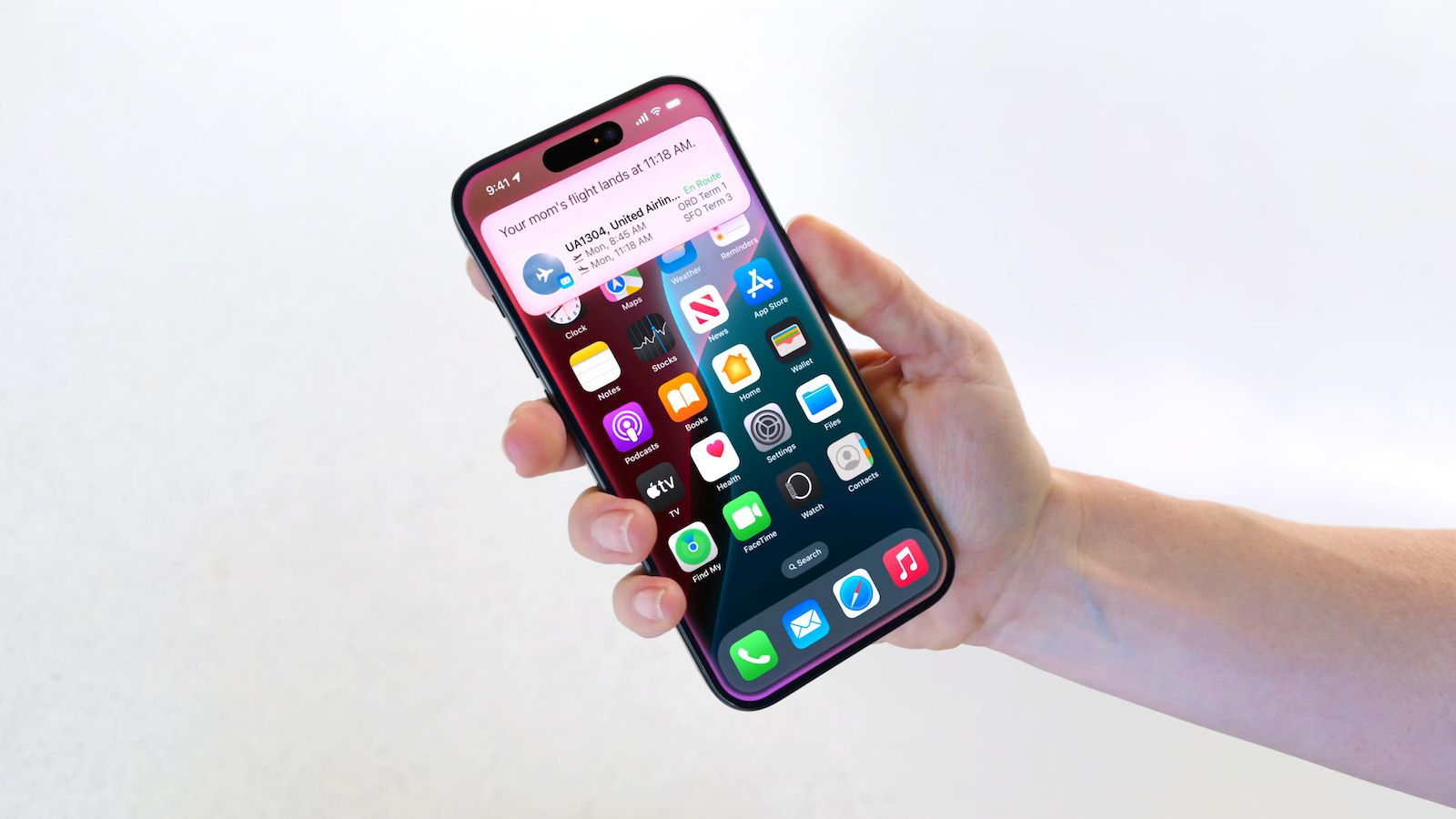
The case is Landsheft versus Apple Inc., number 5:25-cv-2668 in the United States District Court for the Northern District of California, before Judge Noel Wise. It alleges false advertising over Siri features Apple previewed in June 2024 and then delayed: understanding of a user's personal context, awareness of what is on screen, and deeper control of individual apps. Those capabilities were shown at WWDC, put on Apple's website and carried in a television commercial starring the actor Bella Ramsey. In March 2025 Apple delayed the personalised Siri, and the suit followed.
Apple denies the allegations and admits no wrongdoing. It settled, in its own words, "to stay focused on doing what we do best". The 250 million dollars is a non-reversionary common fund, meaning nothing goes back to Apple if claims fall short. Terms were announced in May 2026 and received preliminary approval after a hearing on 8 July, at which the judge rejected an argument that the deal lumps together class members whose claims are worth very different amounts.
Who qualifies and what the form asks
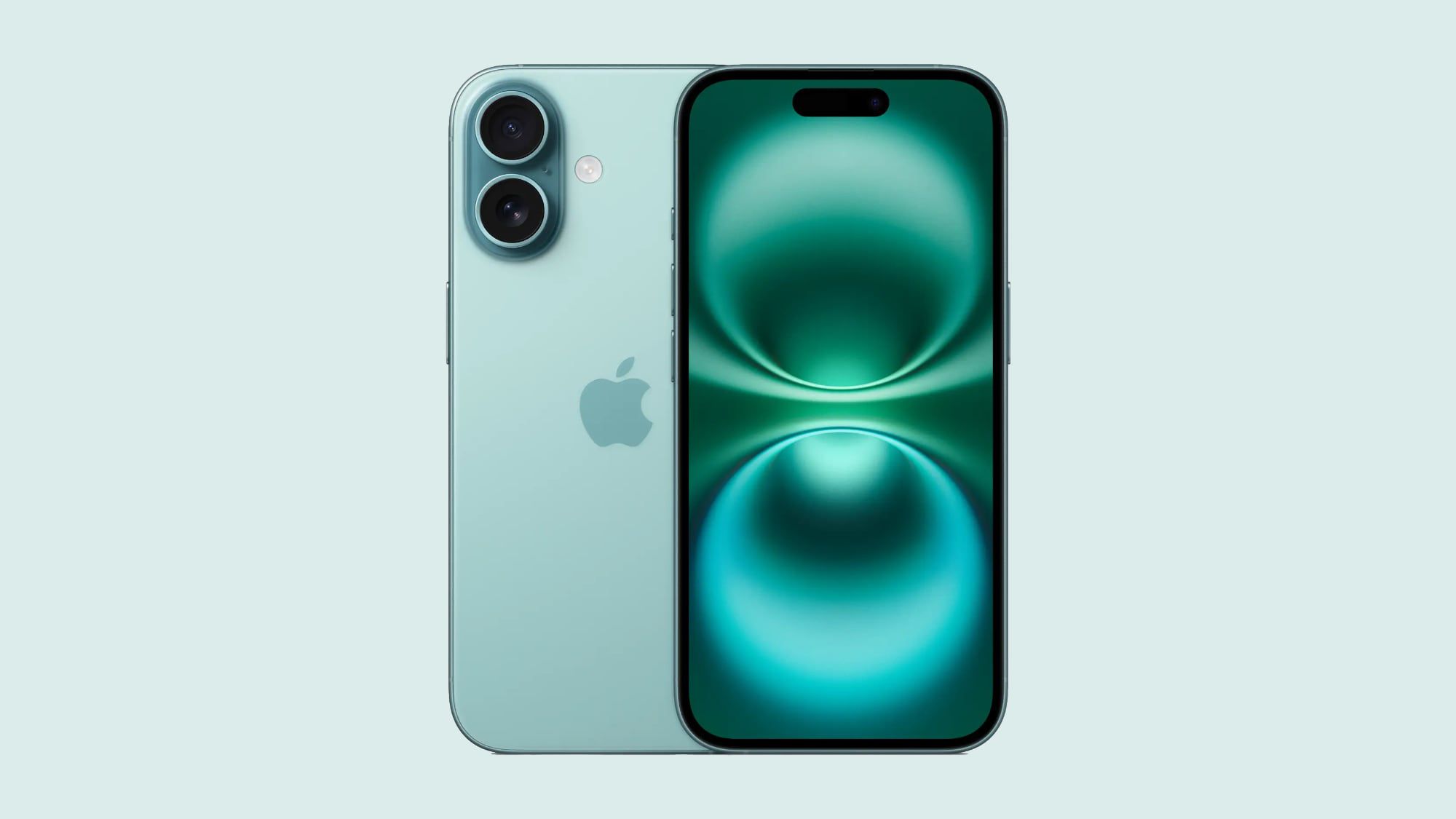
Eligibility is narrow in three ways at once. A claimant must reside in the United States, must have bought the device in the United States for something other than resale, and must have bought it between 10 June 2024 and 29 March 2025. The qualifying models named across the reporting are the iPhone 15 Pro, the iPhone 15 Pro Max and the iPhone 16 line. CBS News put the eligible population at roughly 37 million devices when the terms were announced.
Eligible buyers should receive an email over the coming days carrying a claim identifier and a PIN, but the site accepts a claim without either. The form asks for personal details and the serial number of the qualifying iPhone; a claimant who cannot supply the serial number is asked instead for the Apple Account email address and the phone number that iPhone used. Payment is a presumptive 25 dollars per device. That figure moves with the volume of valid claims, downwards if many are filed and upwards to a stated ceiling of 95 dollars if few are.
Nobody is paid inside the claims window. Payments follow final approval, and here the reporting does not agree. 9to5Mac and AppleInsider both reported in July that the final approval hearing was set for 29 September 2027, with cheques no sooner than 60 days after that. MacRumors reported in August that the judge had set the hearing for 24 February 2027, and repeated that date on 20 September while reading the live settlement site. We have gone with February, because the August account describes a specific action the court took after the July reporting was filed, and because it is the date the later coverage still carries. Anyone relying on it should read the date off the settlement site rather than off any article, this one included.
Our take
The striking thing about this settlement is what it is actually about, because it is not privacy. Apple has settled a Siri case on privacy grounds before, and the two are easy to confuse. This one is about advertising: the allegation is that Apple sold phones on the strength of software that did not exist yet. That is a harder claim to bring and a more consequential one to settle, because the conduct at issue is the ordinary practice of demonstrating unreleased software at a keynote. Settling for 250 million dollars without admitting anything leaves that practice untested, which is very likely the point.
For the people involved, the arithmetic is deflating in a familiar way. A presumptive 25 dollars against a phone that started at 999 dollars is not compensation in any ordinary sense, and the 95 dollar ceiling only arrives if most eligible people never file. The gap between those numbers is a quiet incentive structure: a claimant is better off the fewer of their fellow class members hear about the window. Ninety days is short for something that reaches tens of millions of people, and the notice email is the main mechanism for telling them.
There is an awkward timing detail nobody involved is drawing attention to. Siri AI shipped with iOS 27 this month, on iPhone 15 Pro and newer, and Apple still labels it a beta even though iOS 27 is no longer one. So the class period covers the gap between the promise and the delay, the claims window opens a week after the feature finally arrived, and the feature it arrived as is still marked unfinished. None of that changes anyone's eligibility. It does make the settlement read less like a full stop than like a line drawn partway through.
For anyone who ships software, the useful lesson is about the distance between a demonstration and a commitment. The features in the 2024 presentation were real work in progress, shown the way most unreleased software is shown. What turned them into a legal exposure was that they moved from a keynote into the advertising for a specific product a customer then bought. The line the case draws, without ever testing it in court, sits at that transition rather than at the demonstration itself, and it is worth knowing where it is before the next roadmap slide goes into a campaign.
Sources
 Siri AI Settlement Website Now Live: Apple to Pay Some iPhone OwnersMacRumors, 2026-09-20
 Apple's Siri Settlement: Here's When iPhone Owners Can Submit ClaimsMacRumors, 2026-08-28
 Apple's $250 million Siri settlement just got approved, here's who gets paid9to5Mac, 2026-07-24
 Judge approves Apple's $250 million settlement offer over Siri lawsuitAppleInsider, 2026-07-24
 iPhone owners could get up to $95 from Apple settlement. Here's what to know.CBS News, 2026-05-07
- Smartphone AI SettlementVerita Global, 2026-09-20
Reporting and images linked above belong to their respective publishers and are shown from their own servers. The analysis here is our own.