
CarPlay in iOS 27 can run third-party video apps, and only while the car is parked
iOS 27 lets developers build CarPlay apps people can browse and watch on the car's own screen, gated behind an Apple entitlement, a parked car and automaker support.
Apple added support for third-party video apps to CarPlay in iOS 27, which was released on 14 September 2026.
Apple's developer site now lists video alongside audio, navigation, messaging and the other CarPlay app categories, and describes the capability as letting people browse and watch content "in supported cars when parked". That wording carries both of the significant restrictions. The car has to support the feature, and playback is tied to the vehicle being stationary. Apple covered the details in a WWDC26 session called Rev up your CarPlay app.
The change is narrower than video arriving in cars, because video already had. 9to5Mac points out that iOS 26 allowed video on a CarPlay display through AirPlay streaming, where the user starts playback on the iPhone and sends it to the car's screen. What iOS 27 adds is a browsing interface: developers can build an app that lives on the CarPlay display itself, so the user finds something to watch using the car's screen and controls rather than picking it on the phone first. 9to5Mac also notes that automakers have to sign on, which means it will not appear in every car.
What else changed in CarPlay
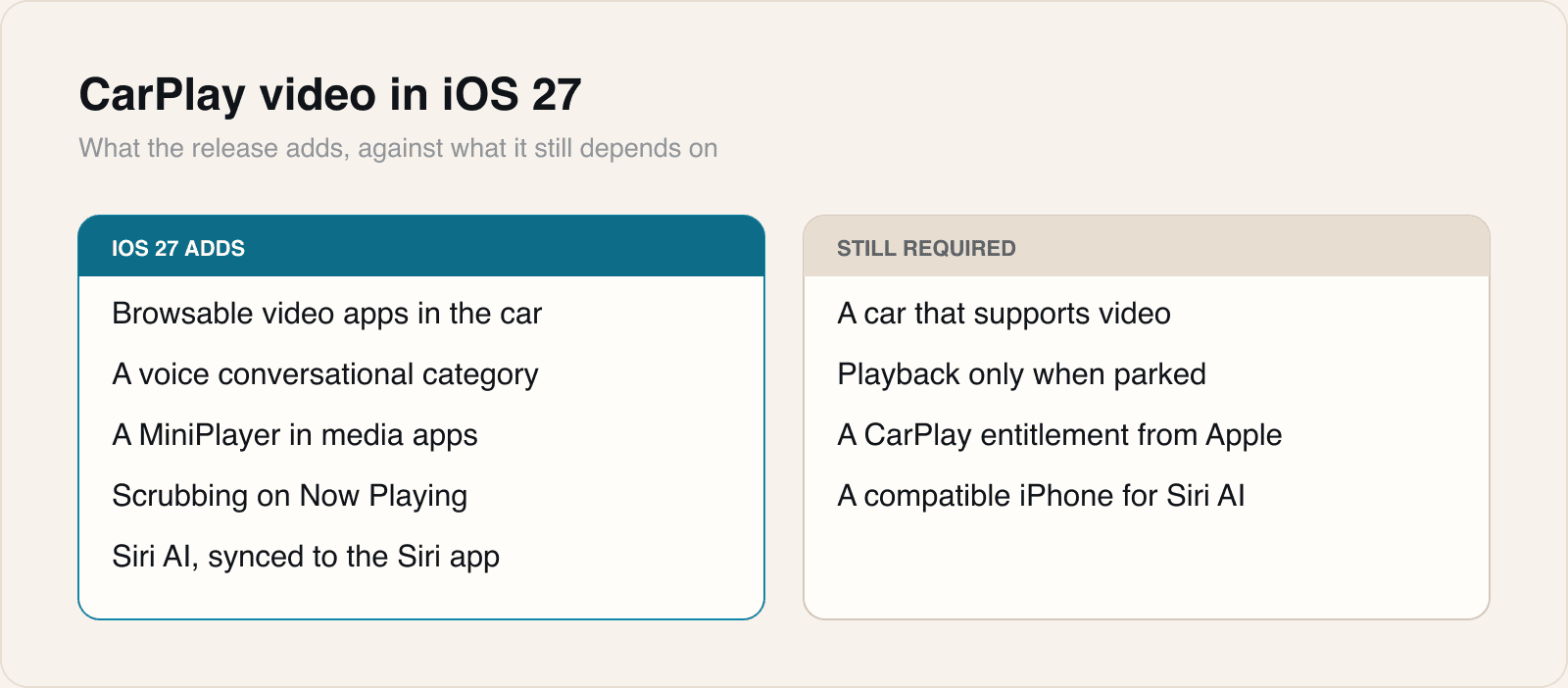
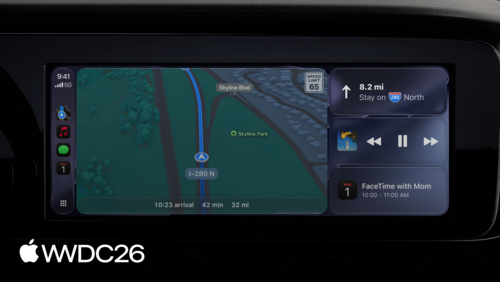
Several smaller changes arrive in the same release. Apple's category list now includes voice-based conversational apps, a genuinely new class of CarPlay app that has drawn almost no attention. Media apps gain a MiniPlayer in the top-right corner of the interface, showing artwork and playback controls in place of the previous waveform icon, and the Now Playing screen supports audio scrubbing through a larger progress indicator. The Liquid Glass app icons introduced across iOS 27 extend to CarPlay, and new wallpapers match those elsewhere in the release.
Siri AI works in CarPlay on a compatible iPhone. 9to5Mac describes it appearing as a glowing orb at the bottom centre of the display, reports that it holds the thread of a conversation better than the previous version, and notes that conversations held in the car sync to the Siri app on the iPhone, marked with a car icon. Developers who want any CarPlay app at all still need the CarPlay app entitlement, which Apple grants on request through a form on its developer site rather than issuing automatically.
What it means
Three separate gates stand between this feature and an actual driver, and they compound. Apple has to grant the entitlement, the automaker has to have implemented support, and the car has to be parked. Each is reasonable on its own; together they describe something most CarPlay users will not encounter this year, or possibly at all in the car they currently own. The automaker gate is the one that matters most, because it is the only one that cannot be cleared by a software update to anything Apple controls. A capability that depends on vehicles shipping with new support is a capability on the motor industry's release cycle, which is measured in model years.
The parked restriction, by contrast, is the part we would defend without hesitation, and it is worth stating clearly because it will be read as timidity. Apple is not being cautious here so much as declining to build the obvious liability. The interesting question is what parked actually means in practice, and neither Apple's page nor the reporting says whether a car stopped at a long red light counts. That is precisely the edge case that determines whether the feature is pleasant or maddening, and nobody has answered it.
The addition we find more significant is the one nobody covered. A category for voice-based conversational apps means third-party assistants have a defined place on the car's screen, in the environment where talking to software is not a novelty but the only sensible interface. That is a structurally larger change than video, which is a parked-car amenity. It has arrived in the same release as Siri AI reaching CarPlay, and the relationship between the two is undocumented in anything we could find.
For anyone thinking of building one of these, the entitlement is the long pole and should be requested before the work rather than after it, since approval is a conversation with Apple on Apple's timeline. Beyond that, the design brief is unusual and easy to get wrong: because playback only happens while parked, the product is the browsing experience, not the player. Nobody is scrubbing through a timeline on a motorway. The screens that matter are the ones that get somebody from sitting down to watching in a handful of glances, and they have to work for a passenger on a charging stop, which is a different user in a different mood from anyone your phone app was designed for.
Sources
 CarPlay - Apple DeveloperApple, 2026-09-14
 Rev up your CarPlay app - WWDC26Apple, 2026-06-09
 CarPlay just got better, here's everything new in iOS 279to5Mac, 2026-09-21
Reporting and images linked above belong to their respective publishers and are shown from their own servers. The analysis here is our own.