iOS 27.2 beta adds a Restrict Motion Data setting, visible only in China
The second iOS 27.2 beta carries a setting that blocks chosen apps from reading the accelerometer and gyroscope, and it appears only on China App Store accounts.
A setting called Restrict Motion Data has appeared in the second beta of iOS 27.2, and it is visible only to iPhones signed in to a mainland China App Store account.
The report comes from the Chinese technology site IT Home, which published it on 23 September 2026 after what it describes as a large volume of reader submissions, crediting more than a dozen tipsters by name. IT Home places the control at Settings, then Privacy and Security, then Motion and Fitness. Switching it on lets the user pick individual apps to restrict. An app on that list loses access to motion sensor data including the accelerometer and the gyroscope, and IT Home notes that some apps behave abnormally or quit unexpectedly once the data stops arriving.
The regional gating is the part readers have tested most. IT Home reports that the entry appears in Settings only while the App Store is signed in to a mainland China account, and disappears on switching to a United States account. It also records a second behaviour that is easy to miss: restrictions configured under a China account stop taking effect once the account is switched, so the setting does not simply become invisible, it stops working.
Attribution matters here more than usual. IT Home is the originating report, and the English-language coverage traces back to it rather than around it. MacRumors credits IT Home, and TechNode, which covers Chinese technology from its own desk, credits IT Home as well. Three outlets carrying the story is not three sources, and nothing in it has been confirmed independently of the users testing the beta.
Apple has said nothing at all about the setting: not what it is for, not whether it will ship, and not whether it will stay limited to one market. The connection everyone has drawn is to shake-to-open advertising, a practice common in Chinese apps in which an advert shown at launch opens a link when the phone is shaken, and where the motion threshold is often loose enough that picking the phone up, walking, or a bump in a moving car is enough to trigger it. IT Home presents that reading as the view of the users who submitted the reports, not as Apple's explanation. This is a beta, and betas change.
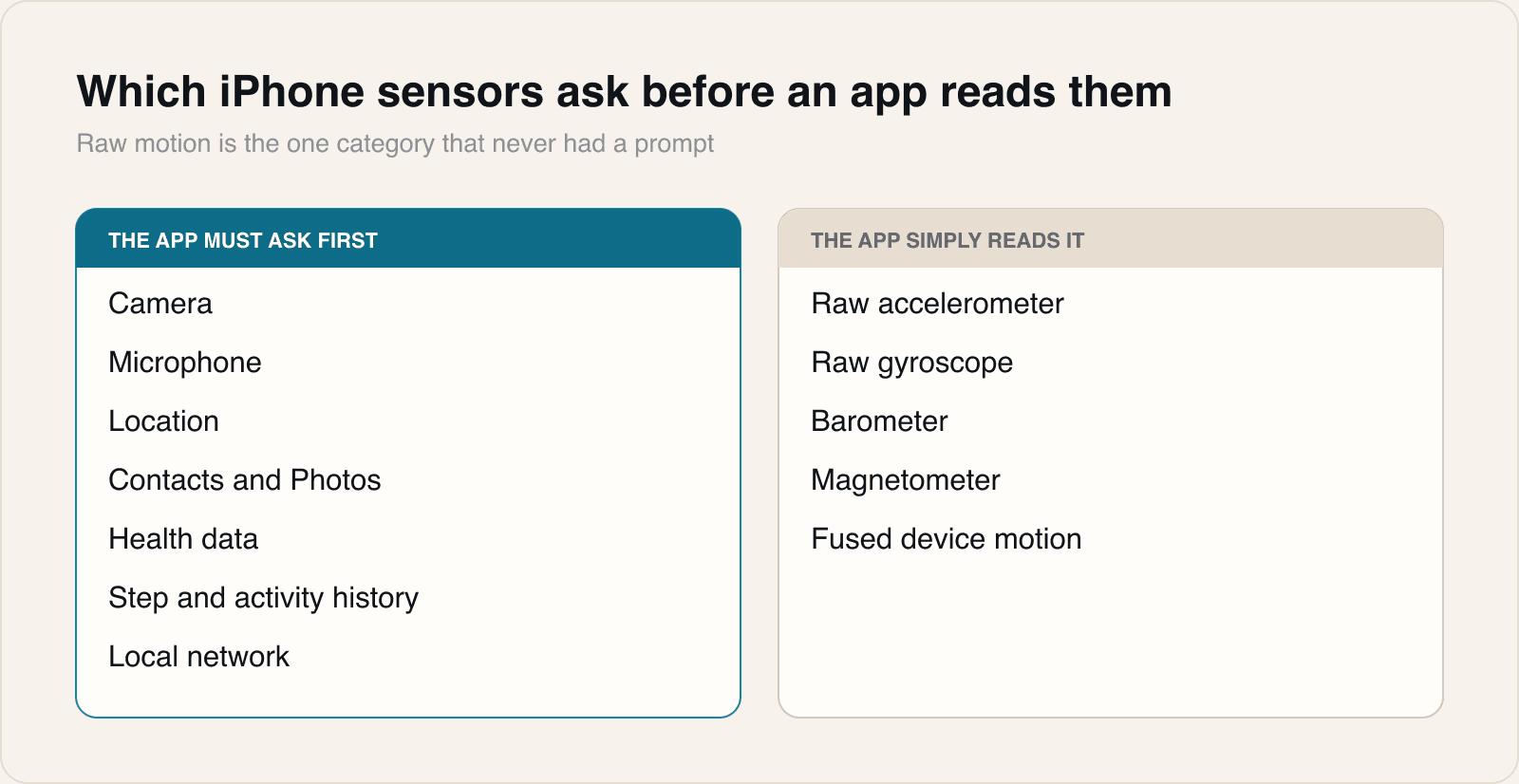
Which sensors have a permission prompt today
Our take
The reason this is worth more attention than a region-locked toggle normally gets is the gap it fills. iOS has spent fifteen years building permission prompts around anything that reveals something about a person, and raw motion never got one. An app asks before it reads the camera, the microphone, your location, your contacts, your photos, your health data or your step and activity history. It does not ask before it reads the accelerometer, the gyroscope, the barometer or the fused device motion stream, and it never has. A game needs that data the moment it launches, so the platform handed it over by default and the cost stayed invisible.
That cost was never really about adverts. Motion data is among the most identifying streams a phone produces. Gait is distinctive enough to be usable as a biometric, accelerometer noise carries manufacturing fingerprints that can help re-identify a specific handset, and a gyroscope samples often enough to have been shown to pick up acoustic vibration. None of that requires a prompt today. The shake-to-open advert is simply the version of the problem that irritates people enough to generate a dozen tip submissions in one day, which is a good illustration of how privacy features actually get built: not from the most serious risk, but from the most annoying symptom of it.
We would be cautious about assuming this stays in one market, and equally cautious about assuming it travels. The pattern in China is real and the argument for confining a fix to the market with the problem is decent. But Apple has form for piloting a control in one region and generalising it, and the underlying capability, an app-by-app switch for motion access, is not China-specific in the slightest. The thing to watch is whether later betas move it, rename it, or attach a permission prompt to it. A blocklist buried in Settings and a prompt at first use are very different products, and only the second changes anything for the majority who never open that screen.
For anyone shipping an app, the practical point is the crashes. IT Home reports that restricted apps can quit unexpectedly, and that is a straightforward bug on the app side rather than a limitation of the setting. Code written against Core Motion generally assumes the sensor stream is always available, because on iOS it always has been, and an app that treats a nil reading or a stalled update handler as impossible will fall over the first time someone restricts it. If your app uses device motion for anything, in a game, a fitness feature, a camera stabiliser or a scroll effect, the defensive work is to handle updates that never arrive and degrade rather than crash. That is worth doing now whether or not this setting ever reaches your users, because it is the same code path as a hardware fault.
It is also worth naming what nobody knows. There is no Apple documentation, no developer release note, no API mentioned anywhere, and no indication of whether an app can detect that it has been restricted or must simply cope. We are not going to invent one. Until Apple says something, the honest description is that a control exists in a beta, a single well-sourced report describes how it behaves, and everything about its future is speculation.
Sources
- Apple iOS 27.2 Beta 2 adds a China-specific option to restrict app access to motion dataIT Home, 2026-09-23
 New iPhone Setting Lets Users Shake Off Motion-Sensing AdsMacRumors, 2026-09-23
 Apple adds China-only motion-data restriction in iOS 27.2 betaTechNode, 2026-09-23
Reporting and images linked above belong to their respective publishers and are shown from their own servers. The analysis here is our own.