iOS 27 adds 32 keyboard languages, and nearly half are Indigenous languages of the Americas
Apple updated its iOS 27 feature availability page on 18 September with 32 new QuickType keyboard languages, taking the total list to 245 entries.
Apple updated its iOS and iPadOS 27 feature availability page on 18 September, adding 32 languages to the QuickType keyboard alongside smaller additions to Dictionary, Siri activation and Visual Look Up.
9to5Mac spotted the update and counted more than 30 new languages and language variants across the page. Apple's list is the primary record and it is checkable: the QuickType keyboard language support section now runs to 245 entries, counting script and input-method variants separately, and the 32 additions are all present on it. Elsewhere on the page, Dictionary definitions and thesaurus entries gain English for Australia and Canada, Activate with Siri gains French for France and German for Germany, and Visual Look Up gains Arabic for Saudi Arabia, traditional Chinese for Hong Kong and Taiwan, Dutch for the Netherlands, Korean, Brazilian Portuguese, Thai and Turkish.
English for the Philippines is the one language that arrives with the full set of typing features rather than a layout alone. It gains autocorrection, predictive typing, inline predictions, multilingual typing and QuickPath, which between them are most of what makes an iOS keyboard feel finished. Punjabi transliteration also gains autocorrection.
What the list is made of
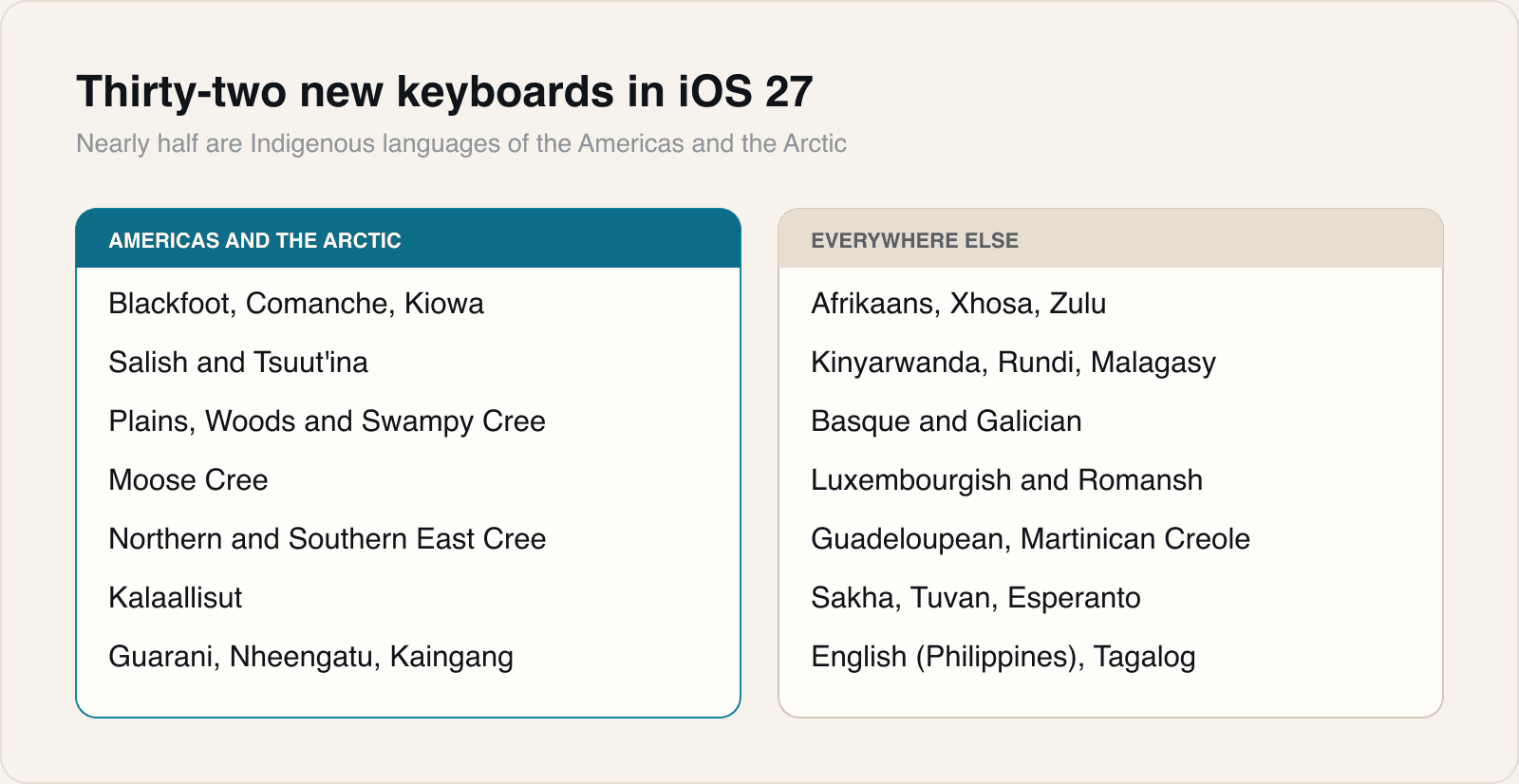
Fifteen of the 32 are Indigenous languages of the Americas or the Arctic. Six are varieties of Cree, listed individually as Moose, Northern East, Southern East, Plains, Swampy and Woods. The others are Blackfoot, Comanche, Kiowa, Tsuut'ina and Salish in North America, Kalaallisut in Greenland, and Guarani, Nheengatu and Kaingang in South America. The remaining additions include Afrikaans, Xhosa and Zulu, Kinyarwanda, Rundi and Malagasy, Basque and Galician, Luxembourgish and Romansh, Guadeloupean and Martinican Creole, Sakha and Tuvan, Esperanto, and a Baybayin layout for Tagalog.
Apple has not published a newsroom post about the additions and did not mention them at the iOS 27 announcement. The feature availability page is the whole of the record.
Our take
This is the least reported substantial thing Apple shipped this week, and the reason is structural rather than editorial. There is no announcement to react to, no demo, and no single user whose day is transformed. There is a table that got longer. It went out on the same day as a phone launch, and a table cannot compete with a queue.
It is worth being precise about what a keyboard layout is and is not. Six Cree keyboards is not six Cree language models. Layout support means the syllabics can be typed at all; autocorrection, predictive typing and QuickPath are listed separately on the same page, and the new entries almost all appear under layout support alone. English for the Philippines is the exception and it is instructive, because it shows what the full stack looks like when Apple decides a language gets it. For the Cree varieties, what has arrived is the floor rather than the ceiling.
That floor still matters more than it sounds. A language that cannot be typed on a phone is, for most practical purposes, a language that does not exist in text messages, in search, in app store reviews or in anything else a phone is used for. Every revitalisation project working in a language with a few thousand speakers has spent years routing around this with third-party keyboards that break on OS updates and cannot be installed without explaining full access permissions to an elder. Shipping the layout in the system keyboard removes a whole category of that work. Listing six Cree varieties separately rather than collapsing them into one entry is a small decision that says somebody asked.
For anyone making apps, the change is a quiet reminder that text input is not a solved problem you can assume away. The immediate consequence is that user-generated text in your app can now arrive in scripts your layout was never tested against, including Canadian Aboriginal syllabics and Baybayin. Fixed-height labels, fonts subset for Latin and Cyrillic, and any string-length heuristic tuned on European languages are all things that fail visibly and only for the users least able to report it. The additions cost you nothing to support and very little to check, and the check is the same one you should already be running: type in the language, look at the screen.
Sources
 iOS and iPadOS 27 Feature AvailabilityApple, 2026-09-18
 iOS 27 and iPadOS 27 expand language support for Dictionary, QuickType Keyboard, more9to5Mac, 2026-09-18
Reporting and images linked above belong to their respective publishers and are shown from their own servers. The analysis here is our own.