OpenAI tells a court that ChatGPT in Siri dramatically underperformed
A court filing from OpenAI says the ChatGPT integration in Apple Intelligence fell far short of its forecasts, and points to Apple's opt-in design.
OpenAI said in a court filing this week that the ChatGPT integration built into Apple Intelligence attracted far fewer users than it had forecast.
The filing is OpenAI's motion for summary judgment in the antitrust case brought by X Corp and SpaceXAI in federal court in Texas, and it was first reported by the Financial Times. As relayed by 9to5Mac, the document says OpenAI expected a halo effect from the association with Apple when the two companies agreed terms in 2024, along with subscriptions converted from Apple Intelligence users. Roughly a month after the integration went live it appeared to be off to a slow start, OpenAI cut its forecast for weekly active users, and by the summer of 2025 the filing describes the integration as dramatically underperforming.
AppleInsider read the same document and dates the sequence differently. Its account puts the launch in December 2024, has forecasts being cut by January 2025, and says sections D and F of the filing classify the integration as persistently underperforming by March 2026. Both readings agree on the direction and on the explanation OpenAI offers: the ChatGPT handoff was opt-in and switched off by default, so a user who wanted ChatGPT was more likely to open the ChatGPT app. Large parts of the filing are redacted, and no unredacted user number or revenue figure appears in any of the reporting.
How the case reached this point
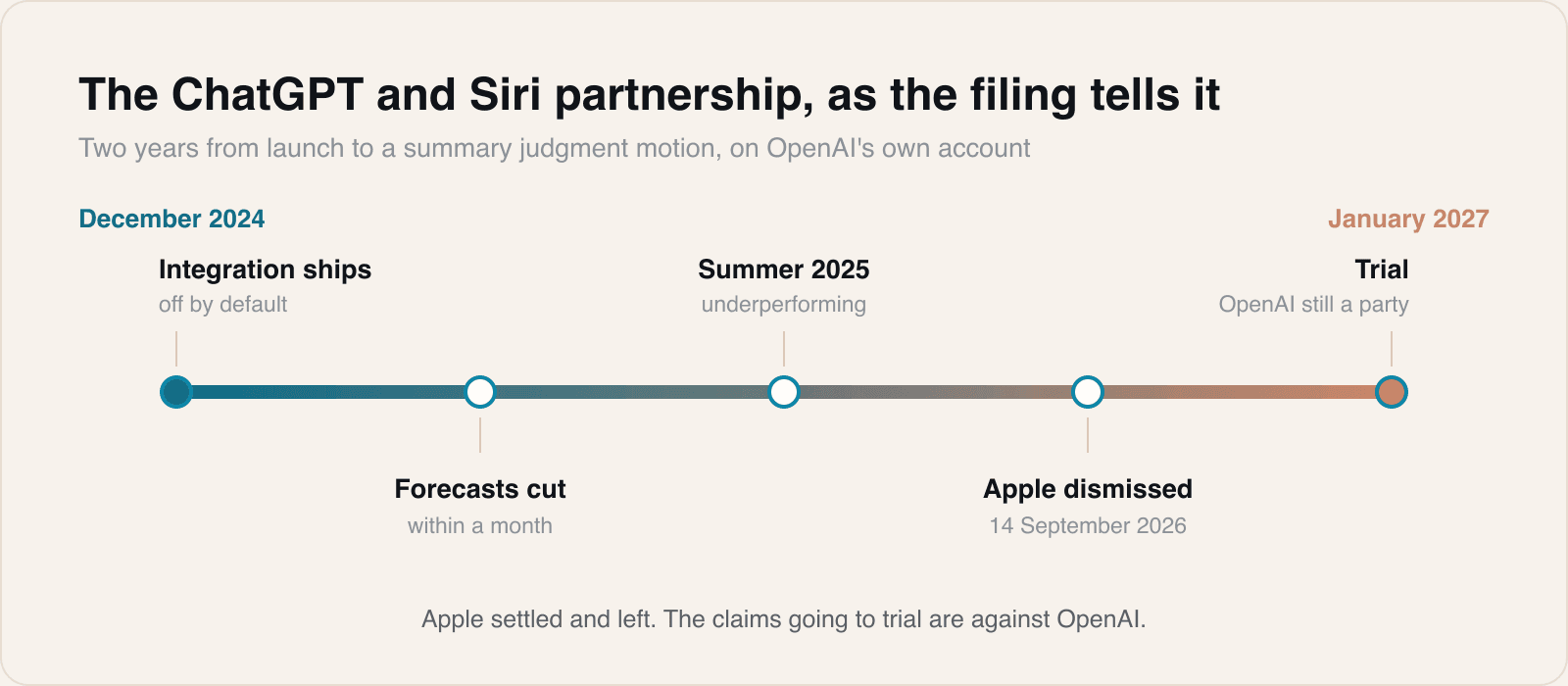
Apple is no longer a defendant. X Corp and SpaceXAI moved to dismiss their claims against the company on 14 September, in a filing that gave no reasons and did not confirm a settlement, as Reuters reported through CNBC. The claims against OpenAI continue, and on 17 September Judge Mark Pittman refused OpenAI access to the confidential agreement between Apple and the plaintiffs, finding it did not bear on the issues before him. OpenAI is now asking the court to rule for it before trial, arguing among other things that SpaceX's own securities disclosures are, in its words, "replete with disclosures diametrically opposed" to the harm alleged. Trial is currently set for January.
Our take
Strip the litigation away and what is left is the most specific thing anyone has said in public about how much Apple Intelligence users actually wanted a third-party chatbot inside Siri. The answer, from the party with every commercial reason to have measured it, is not much. That is worth more than the adjectives suggest, because OpenAI is not a hostile observer here. It built the integration, it wanted it to work, and it was tracking conversion closely enough to revise its numbers within a month.
The reason OpenAI gives is the part app makers should sit with, because it is not really about artificial intelligence. A capability that lives behind a system toggle, switched off until the user finds it and turns it on, reaches a small fraction of the people who have the device. Everybody knows this and almost everybody still ships the toggle, because opt-in is the safe answer to a privacy question and privacy was the whole point of Apple's design. Both things are true at once: Apple made the defensible choice, and the defensible choice produced adoption so weak that its partner is now describing it in a legal brief. If your own product depends on a user enabling something in Settings, this is your data point.
We would weigh the language with some care all the same. This is an adversarial filing whose purpose is to show that the Apple arrangement conferred no meaningful advantage, because a deal that achieved nothing cannot have foreclosed a competitor. Describing your own product's performance as dramatic underperformance is unhelpful commercially and extremely helpful legally, and OpenAI chose to say it in the venue where it pays off. The direction of the claim is credible. The intensity of it is an argument.
The strategic reading follows Apple's own behaviour since. Craig Federighi talked in 2024 about users eventually choosing between models, naming Google Gemini as a candidate, and no second Siri extension has shipped in the two years since. Apple has instead built Gemini models into its own foundation stack for Siri AI, where the user chooses nothing and sees no third-party brand, and has opened Xcode to coding agents from several vendors, where the user is a developer who does want to choose. That is a coherent position rather than a retreat: pick the model yourself in the tool for professionals, and hide the question entirely in the assistant for everyone else. The ChatGPT extension was the version of the future where ordinary users pick their chatbot, and on this evidence they did not want to.
What we still do not know is the size of any of it. No weekly active user count, no conversion rate and no payment terms have been unsealed, so nobody outside the case can say whether dramatic underperformance means a tenth of the forecast or a half. Anyone quoting this filing as proof that Apple Intelligence has few users is reading something into it that is not there. It describes one opt-in feature inside Apple Intelligence, not the platform.
Sources
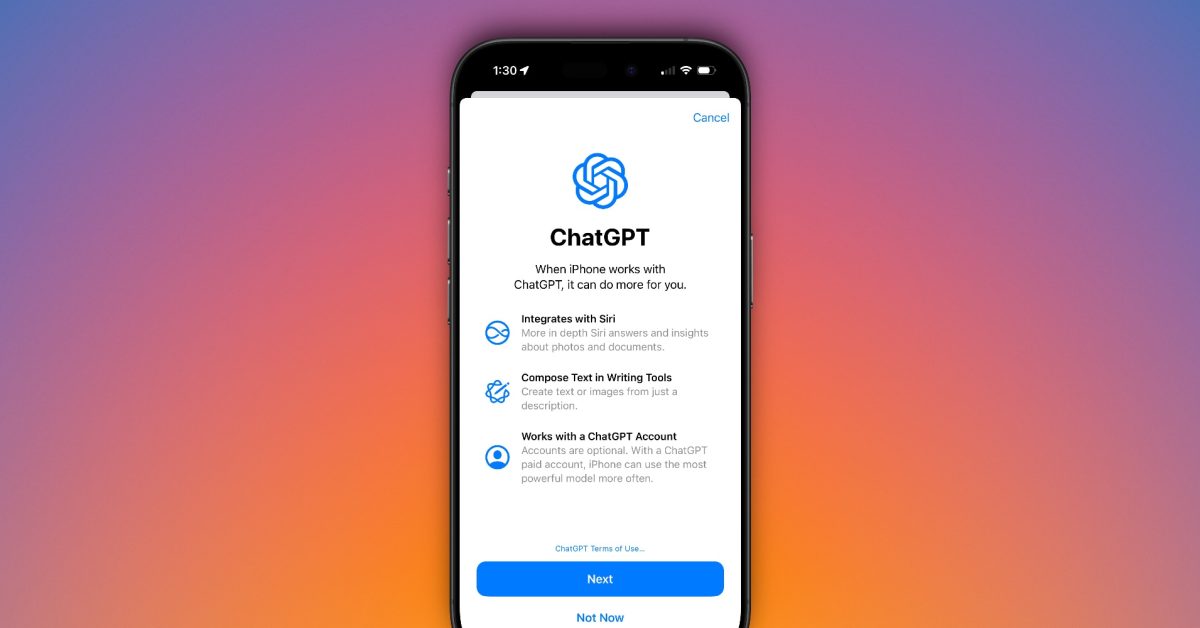 OpenAI says Apple Intelligence users showed little interest in ChatGPT integration9to5Mac, 2026-09-23
 ChatGPT as an extension in Siri dramatically underperformed, says OpenAIAppleInsider, 2026-09-24
 Musk's X Corp and SpaceXAI resolve antitrust lawsuit against AppleCNBC, 2026-09-14
 Judge rejects OpenAI's bid to see X's confidential settlement with Apple in antitrust lawsuit9to5Mac, 2026-09-17
Reporting and images linked above belong to their respective publishers and are shown from their own servers. The analysis here is our own.