
Apple renews its Qualcomm patent licence as its own modem takes over
Qualcomm has announced a renewal of its global patent licence with Apple from April 2027, in the same year Apple's own modem reaches almost every device.
Qualcomm announced on 24 September 2026 that it has renewed its global patent licence agreement with Apple, effective 1 April 2027.
The announcement is brief. Qualcomm will continue to license its portfolio of cellular and connectivity patents to Apple across Apple's product line, and John Han, who runs Qualcomm Technology Licensing, is quoted saying the company is "pleased to extend the Apple license agreement". Neither the financial terms nor the length of the renewal is disclosed.
The agreement being renewed dates from 2019, when Apple and Qualcomm settled several years of patent litigation. That settlement carried a six-year licence beginning 1 April 2019 with a two-year extension option, which was exercised, taking the expiry to 31 March 2027. MacRumors notes that Reuters reported a further two-year option existed, so the renewed term may run to March 2029, but Qualcomm has not said and the possibility should not be read as a term.
Which devices still carry a Qualcomm modem
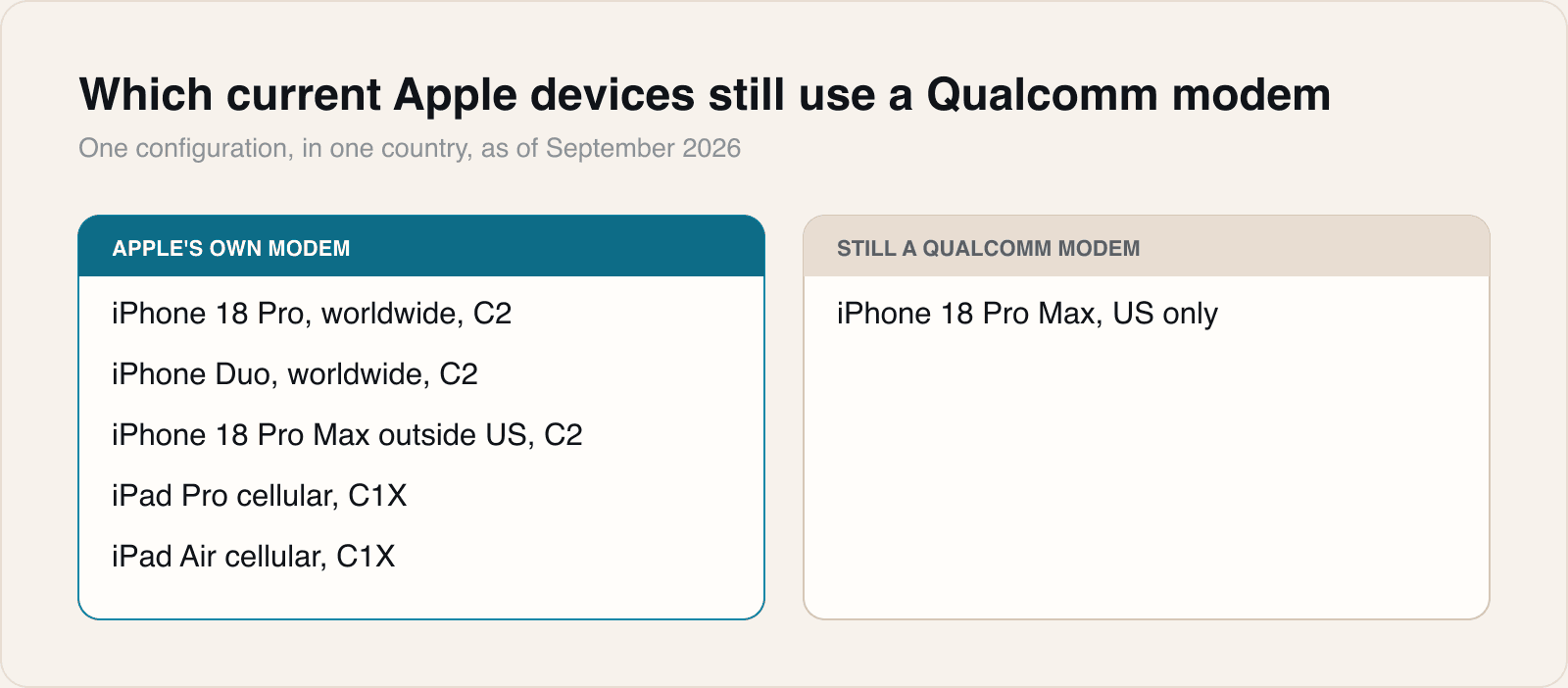
The patent licence is a separate agreement from modem supply, and the distinction matters this year more than it has before. Qualcomm's arrangement to supply Apple with cellular modems runs through 2026 launches. On the current hardware, MacRumors reports that only the United States version of the iPhone 18 Pro Max still ships a Qualcomm modem. The iPhone 18 Pro and the iPhone Duo use Apple's C2 worldwide, as does the iPhone 18 Pro Max everywhere outside the United States, and cellular iPad Pro and iPad Air models use the previous-generation C1X.
Our take
The obvious reading of this announcement is that Apple's modem project has not gone as far as it looks. We think that reading is wrong, and the reason is the difference between a chip and a patent. Designing your own modem frees you from buying someone else's silicon. It does not free you from the patents that describe how cellular networks work, because those are standard-essential: any device that talks to an LTE or 5G network practises them, whoever fabricated the part. Apple can build every modem it ships and still owe Qualcomm a licence, and that is precisely the arrangement being renewed.
Read that way, the timing is the interesting part rather than the fact. Apple is signing a licence that begins in April 2027, by which point its own modem will be in essentially the entire line. It is committing to keep paying for the patents at the moment it stops buying the chips. That is not a company hedging on its silicon; it is a company that has accepted the licence is a permanent cost of selling phones and has chosen to settle it well ahead of expiry rather than negotiate against a deadline.
What nobody outside the two companies knows is the price, and the silence is conspicuous. The 2019 settlement was widely understood to be expensive for Apple, and the leverage has moved since: Apple no longer needs Qualcomm's chips, which removes supply from the negotiation, but it still needs the patents, which does not. Both directions are arguable and neither is knowable from what has been published. Anyone telling you the renewal is cheaper or dearer than the last one is guessing, and Qualcomm's release gives them nothing to guess from.
The undisclosed duration deserves the same scepticism. The two-year option Reuters described would carry the agreement to March 2029, and it is a reasonable inference, but Qualcomm chose to announce an effective date and no end date. A company with a long term to advertise generally advertises it. That may mean the term is short, or that the structure changed enough that a single number no longer describes it, or simply that Apple preferred not to have one published. We would not build a timeline on it.
For anyone building on Apple hardware, the practical consequence is close to nil, and that is worth saying plainly rather than manufacturing one. No API changes, no capability appears or disappears, and the modem transition was already visible in the specification sheets. The one detail with any operational weight is the one in the figure: for now there is a single configuration, in a single country, on a different modem from the rest of the range. If you ship anything sensitive to cellular behaviour, that is the device that will behave unlike its siblings, and it is a United States iPhone 18 Pro Max.
Sources
 Qualcomm Announces Renewal of Global Patent License Agreement with AppleQualcomm, 2026-09-24
 Qualcomm Announces Renewed Agreement With AppleMacRumors, 2026-09-24
 Apple and Qualcomm renew global patent licensing agreementAppleInsider, 2026-09-24
Reporting and images linked above belong to their respective publishers and are shown from their own servers. The analysis here is our own.