A jury orders Apple to pay 5.7 billion dollars over Taptic Engine patents
A federal jury in San Diego has found that Apple's Taptic Engine infringes two Taction Technology patents, and awarded more than 5.7 billion dollars.
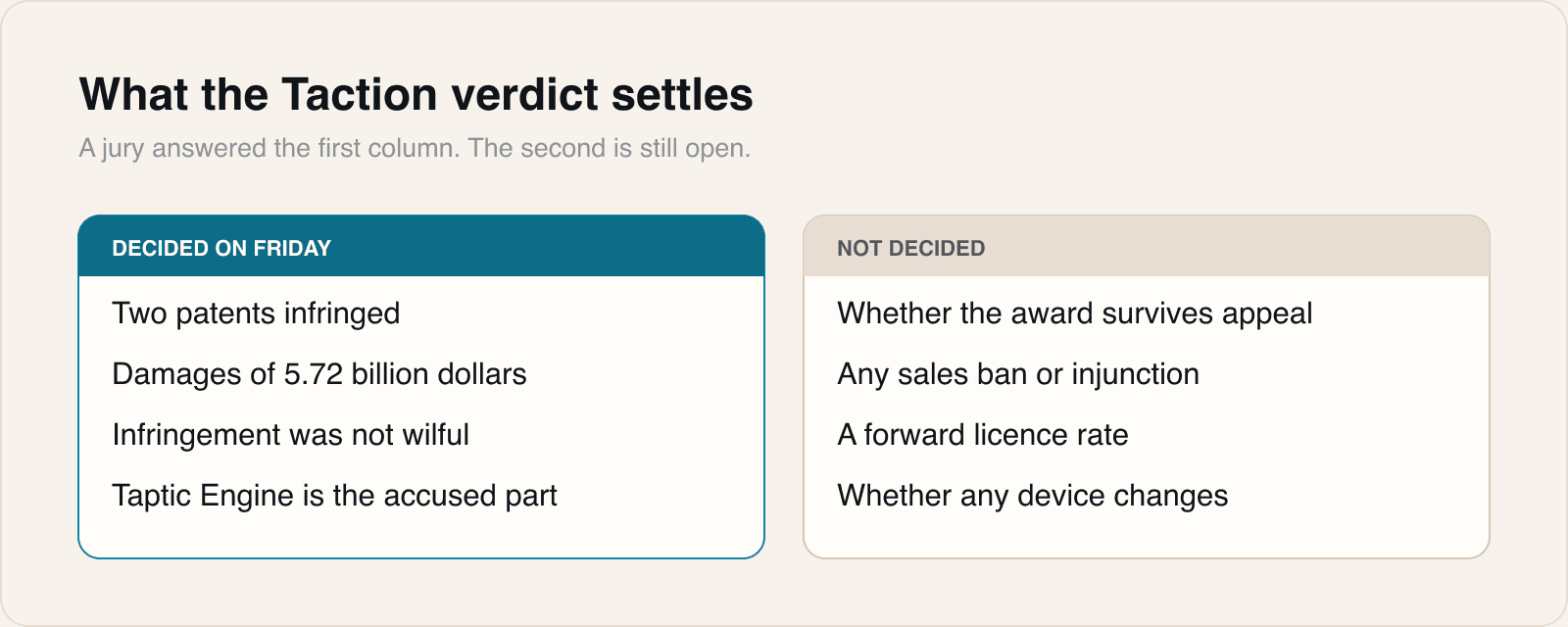
A federal jury in San Diego found on Friday afternoon that Apple's Taptic Engine infringes two patents held by Taction Technology, and awarded the company more than 5.7 billion dollars.
The exact figure on the verdict form is 5,721,961,750 dollars, according to AppleInsider. The case was heard in the United States District Court for the Southern District of California. Seven jurors deliberated for two days after a trial that opened on 14 September, and returned their verdict at 1:15 p.m. Pacific time. The two patents at issue are United States Patent Nos. 10,659,885 and 10,820,117, both covering vibration modules that apply tactile sensation to a user's skin. Taction alleged that the Taptic Engine, the linear actuator Apple introduced with the first Apple Watch in 2014 and later carried into the iPhone, reads on those claims.
The jury did not find that Apple infringed wilfully, which matters because wilfulness is what opens the door to enhanced damages. Taction filed the case in April 2021. A San Diego judge dismissed it in 2023, and the United States Court of Appeals for the Federal Circuit revived it in 2025, putting the dispute back on a trial calendar five and a half years after it began. Apple said it disagrees with both the verdict and the damages, describing its own component as fundamentally different, and added that it "does not use Taction's technology, and we will appeal". Lance Yang, appearing for Taction, said the jury "vindicated its patent rights". Neither wire nor trade reporting describes an injunction being sought or granted.
What the verdict decides
Our take
The number is the story everywhere else, and it is the least durable thing in the case. A jury award is the opening position in a long procedural sequence, not a payment. Post-trial motions come first, in which Apple will ask the trial judge to set aside or reduce the figure, and then an appeal to the same Federal Circuit that revived the case in the first place. That court has a well documented habit of scrutinising damages methodology in large patent awards, and the size of this one guarantees the methodology gets read closely. Anyone treating 5.7 billion dollars as a settled liability is reading a first draft as a final one.
The absence of a wilfulness finding is the detail worth holding on to. A jury that believed Apple knowingly took someone else's invention had the option of saying so, and declined. That removes the possibility of trebling, and it also shapes how the appeal reads: this is a dispute about whether a component Apple says it designed independently happens to fall inside someone else's claims, not about whether Apple knew it was copying. Taction's allegation that Apple reverse engineered its headset technology is reported by AppleInsider as the company's argument. The jury's verdict form, on the willfulness question, does not endorse it.
What does this change for the person holding an iPhone? On the evidence available, nothing at all. No reporting describes an injunction, and damages verdicts compensate for sales that already happened rather than blocking the ones that have not. The Taptic Engine is not going to be switched off, redesigned in an update or removed from a shipping product because of a jury form. The more interesting question is the one nobody has answered yet, which is what a forward licence costs. A verdict establishes a past number; it does not establish a rate Apple pays from here, and that negotiation, or the next trial about it, is where the practical consequence lives.
For anyone building apps, we would resist the instinct that runs through developer forums whenever a hardware patent case lands. This is about a physical transducer and the way it is driven, not about the software interfaces that reach it. Nothing in the reporting touches Core Haptics, the feedback generators in UIKit, or a developer's right to play a haptic pattern. Apple's own supply chain and its own engineering carry this exposure, as they do with every component patent dispute, and the licence that eventually covers it will be Apple's to buy. The sensible response to a headline of this size is to note the number, note that it is provisional, and carry on shipping.
It is worth keeping the scale in proportion. Wire reporting calls this the largest patent infringement award a United States jury has returned, which tells you something about the compounding arithmetic of a component that ships in every watch and every phone for a decade. It tells you much less about the strength of the underlying claims. Very large awards attract very thorough appellate review precisely because they are very large, and the most likely outcome of the next two years is a smaller number arrived at slowly. We will report it when it arrives, and not before.
Sources
 Apple owes Taction $5.7B after losing haptic feedback IP trialAppleInsider, 2026-09-26
 Apple hit with $5.7 billion verdict over Taptic Engine patent infringement9to5Mac, 2026-09-27
 Jury Says Apple Owes Record $5.7B in Haptic Technology Patent CaseInsurance Journal, 2026-09-28
 Jury Orders Apple to Pay $5.7 Billion in Taction Haptic Patent CaseiClarified, 2026-09-26
Reporting and images linked above belong to their respective publishers and are shown from their own servers. The analysis here is our own.