
Apple Podcasts Subscriptions will add video for paying subscribers
Apple has told creators that Apple Podcasts Subscriptions will support video, covering subscriber-only episodes, ad-free video, early access and bonus content.
Apple announced on 23 September 2026 that Apple Podcasts Subscriptions will support video, letting creators sell video episodes to paying subscribers.
The announcement went to creators through Apple's own Podcasts for Creators site rather than the Apple Newsroom. Apple says the feature will cover, in its wording, "subscriber-exclusive episodes, ad-free video, early access, and bonus content", and will reach audiences in more than 170 countries and regions, across Apple devices and on the web. Apple frames the benefit in three parts: a new way for creators to build a business, delivery of audio and video without maintaining separate workflows, and playback wherever the audience already listens.
Two details are conspicuous by their absence. Apple gives no release date, saying only that the feature is coming soon. And it names no hosting providers. The post says Apple is working with hosting providers across the industry and that details from participating partners will follow in the coming months, which is as far as the commitment goes.
The announcement completes a sequence rather than starting one. Apple Podcasts Subscriptions launched in 2021 as a way to sell premium audio, with the same reach of more than 170 countries and regions. Earlier in 2026 Apple introduced a video podcast experience built on HTTP Live Streaming, letting listeners switch between watching and listening, play full screen and download video for offline viewing. With iOS 27 and the updates alongside it, Apple extended video in Podcasts with read-along transcripts, chapters, media links, and playback on the Mac and Apple TV. Video was already in the app. What changes now is that it can sit behind a paywall.
Whether your podcast host can deliver it
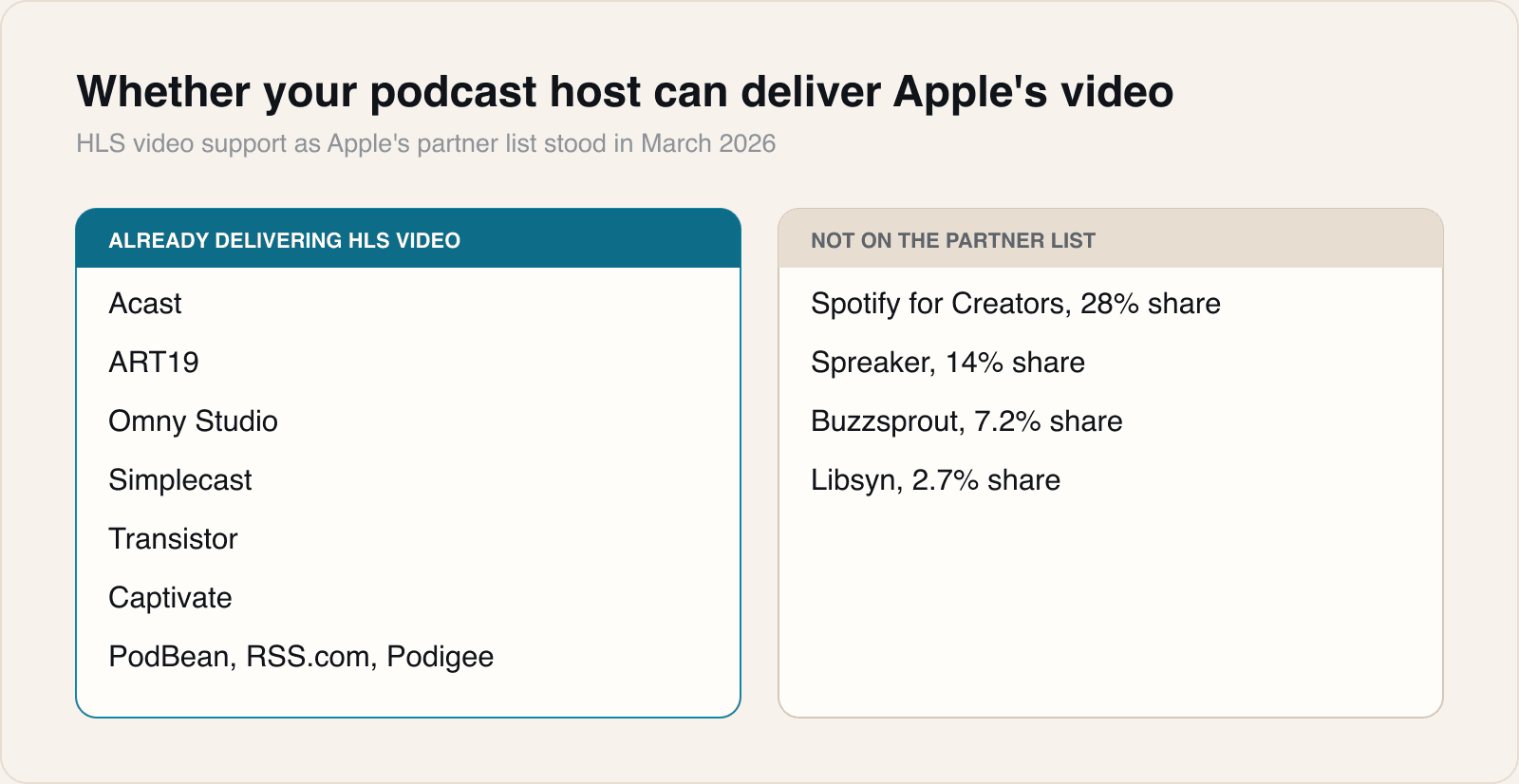
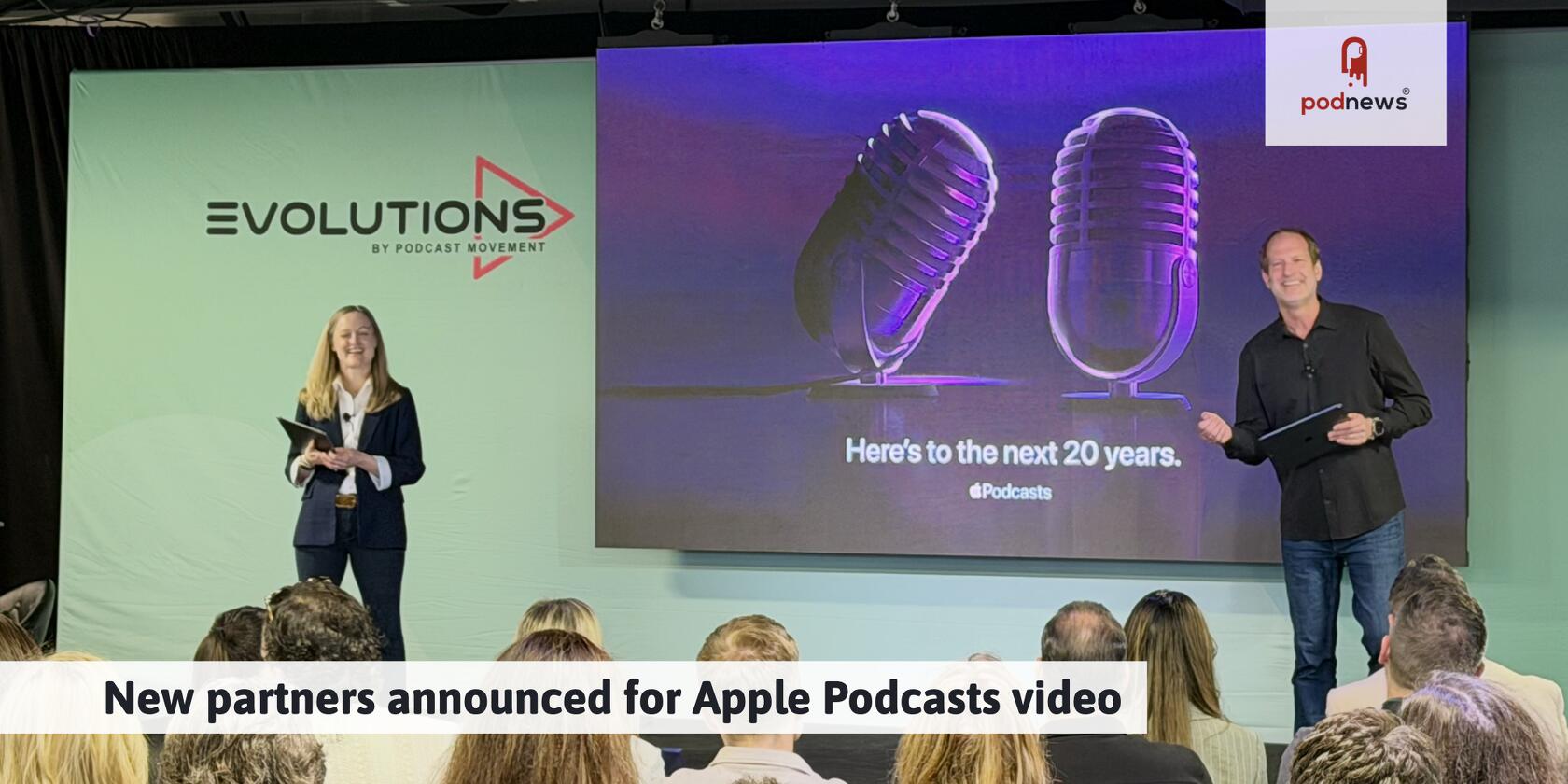
Because Apple's video podcasts are delivered over HLS rather than as a plain media file in an RSS feed, a show cannot opt in on its own. The hosting provider has to support the format, and when Apple last expanded that partner list publicly, in March 2026, Podnews reported ten names on it: Acast, ART19, Omny Studio and Simplecast, joined by Transistor, Audiomeans, PodBean, Captivate, RSS.com and Podigee. Podnews also recorded who was missing, and by its market share figures the absentees included Spotify for Creators and Megaphone at 28 percent, Spreaker at 14 percent, Buzzsprout at 7.2 percent and Libsyn at 2.7 percent.
Our take
The gap between an announcement made to creators and a feature creators can use runs straight through that partner list. Apple has described what subscribers will be able to buy without saying who will be able to sell it, and the honest answer for most shows today is that it depends on a decision their host has not announced. A creator reading Apple's post and wondering what to do this week should start by asking their hosting provider whether HLS video is on the roadmap, because nothing else in the plan matters until that is settled.
The market-share numbers are the part worth sitting with. If the hosts outside the partner list still account for a little over half of shows, then a majority of podcasters cannot act on this announcement at all, and the ones who can are concentrated among hosts that court professional and network clients. That is not an accident of timing so much as a description of who Apple built the feature for. Premium video subscriptions are a tool for shows that already have a paying audience and a production budget, and Apple's own framing, which talks about growing a business rather than starting one, says as much.
There is also a cost question nobody has answered. Hosting video is dramatically more expensive than hosting audio, and HLS delivery means encoding into multiple renditions rather than storing one file. Every host that has added video so far has treated it as a paid tier, and it would be surprising if that changed. So the real price of a video subscription is not Apple's commission, which creators already understand, but a hosting bill that scales with how many people watch. A show weighing this up should model the hosting cost against expected subscriber revenue before it models anything else.
The strategic reading is more interesting than the feature. Video podcasting today largely means YouTube, where distribution is free, discovery is enormous and monetisation belongs to the platform. Apple cannot match the first two, so it is competing on the third: keep the subscription relationship, keep the audience inside an app people already use for audio, and let creators charge directly rather than depend on advertising rates. That is a coherent position and a narrow one. It will appeal to shows whose economics already rest on direct subscriptions, and it will not move a show that measures itself in views.
What we would watch for is the partner announcement Apple deferred. The names that appear over the coming months, and whether any of the large absent hosts are among them, will say far more about how widely this gets used than anything in yesterday's post. Until then this is a firm commitment with an unstated date and an unstated reach.
Sources
 Video is coming to Apple Podcasts SubscriptionsApple Podcasts for Creators, 2026-09-23
 Apple Podcasts Subscriptions Will Soon Support VideoMacRumors, 2026-09-23
 Apple Podcasts will soon let creators offer exclusive videos to subscribers9to5Mac, 2026-09-23
 New partners announced for Apple Podcasts videoPodnews, 2026-03-16
Reporting and images linked above belong to their respective publishers and are shown from their own servers. The analysis here is our own.