
AT&T will not commit to iPhone Handoff, leaving T-Mobile alone in the US
AT&T has declined to commit to iPhone Handoff, the iOS 27 feature that shares one number across two iPhones, leaving T-Mobile as the only US carrier offering it.
AT&T has declined to say whether it will support iPhone Handoff, the iOS 27 feature that lets one phone number move between two iPhones.
A spokesperson told CNET that the carrier sees "potential in capabilities like iPhone Handoff" but that, in the same statement, "our focus remains on delivering innovations that make life simpler". The spokesperson then pointed to existing eSIM activation and transfer options across compatible devices. The statement stops short of ruling the feature out and offers no timeline, which leaves AT&T the only large American carrier that has neither shipped it nor promised it.
Which carriers support it, and what they charge
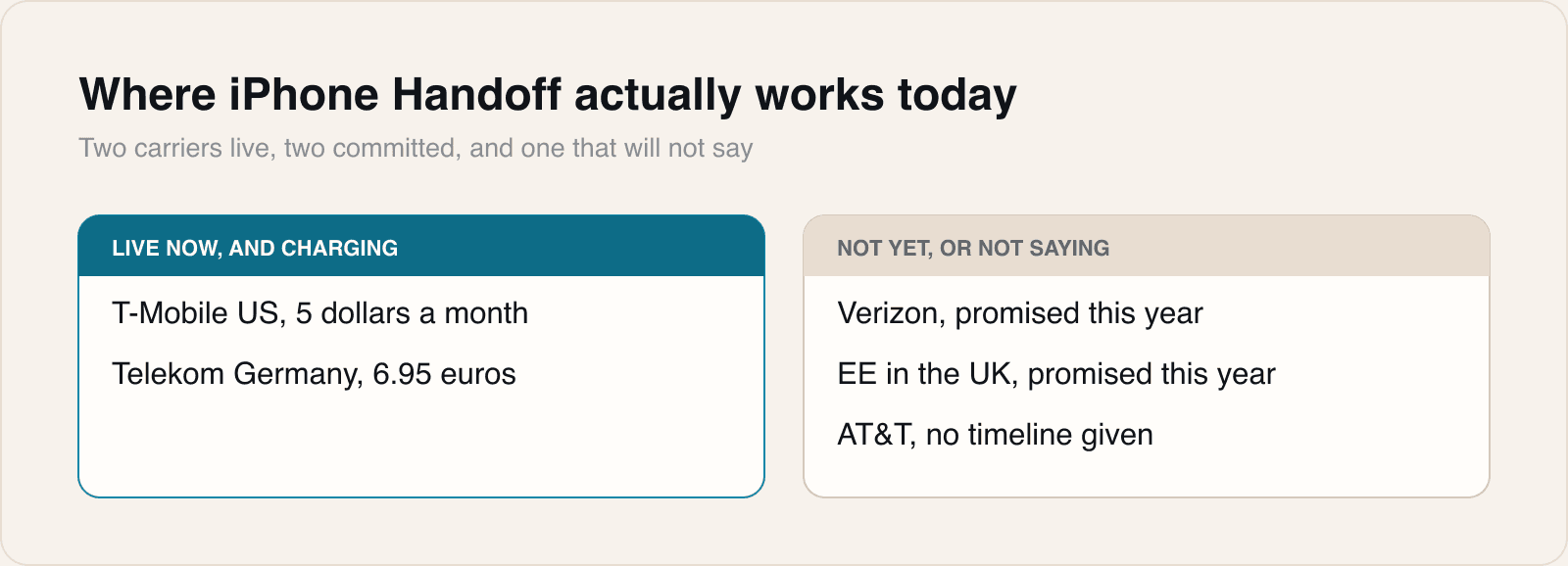
T-Mobile is the only carrier offering iPhone Handoff in the United States and charges 5 dollars a month for it, saying the feature works on any iPhone running iOS 27 and is ready from day one on the iPhone 18 Pro line and the iPhone Duo. Telekom in Germany was the other launch partner, and MacRumors reports a charge of 6.95 euros a month, applied only on plans that do not already include multi-SIM. Apple has said Verizon and the UK's EE will add support later this year, with more carriers to follow.
Apple's own support document sets out what the feature requires and, more usefully, where it stops. Both iPhones must run iOS 27 or later and be signed in to the same Apple Account, with FaceTime and iMessage on that account and Messages in iCloud enabled for messages to follow. Setup designates one handset the main iPhone and the other the secondary, and the shared number is active on one at a time. Apple states plainly that carrier fees might apply.
The limitations in that document are the details the carrier story has skipped. Call forwarding, caller ID and account management work only on the main iPhone. An Apple Watch does not move with the number, so a paired watch stays tied to the phone it was set up with. Wallet items including transit passes, identity cards and corporate badges might work on only one device at a time. And turning iPhone Handoff off is not something the user can do alone: Apple's instruction is to contact the carrier.
Our take
The interesting thing here is not that AT&T is dragging its feet, it is that the feature was designed so that a carrier could. Apple shipped iPhone Handoff in iOS 27 for every compatible iPhone, and then made it depend on network-side provisioning that each operator decides separately. That is the opposite of how Apple normally launches a headline feature, and it puts the company in the position of advertising something a large share of its customers cannot switch on, with no way to tell them when they will be able to.
AT&T's pointing at eSIM transfer is the tell, and it is not quite the misunderstanding it has been read as. Moving an eSIM between two phones and having a number follow whichever phone you pick up are different products, and anyone who has done the former knows it is a chore rather than a feature. But eSIM transfer is a thing AT&T already supports and earns nothing extra from, and iPhone Handoff is a thing it would have to build for. A carrier that has not decided whether the engineering pays for itself will reach for the option it already ships. Read that way, the statement is not confusion about the feature, it is a pricing decision that has not been made.
That every launch carrier charges for it is the part customers should weigh, because it reframes what is being sold. Five dollars a month is 60 dollars a year for what is, from the network's side, an entry in a subscriber database saying a number may terminate on either of two SIMs. There is real work behind that, in billing, in provisioning and in emergency call routing, but it is not a recurring cost that scales with use. Carriers are pricing it as a feature subscription because a second line has always been a feature subscription, and this replaces one at a fraction of the price. It remains much cheaper than a second plan, which is presumably why nobody has objected loudly.
The limitation we would want understood before anyone pays is the Apple Watch. A person who buys a second iPhone specifically so they can leave the large one behind is very likely wearing a watch, and the watch does not follow. So the scenario that sells the feature, picking up the smaller phone and walking out, quietly leaves the watch pointing at a handset that is no longer carrying the number. Apple states this clearly in its support document and none of the coverage mentions it, which is a reasonable measure of how much attention the fine print has had.
The requirement to ring the carrier to switch it off deserves the same scepticism. A feature you can enable in Settings and cannot disable in Settings is a feature with a retention mechanism attached, whether or not that was anyone's intention. It is also a support burden the carriers have chosen for themselves, and a reason to expect the ones still deciding to take their time. If you are weighing this up, our advice is to treat it as a line on your bill rather than a setting on your phone, because that is how leaving it will feel.
Sources
- Set up iPhone HandoffApple, 2026-09-15
 AT&T Responds to iOS 27's New iPhone Handoff FeatureMacRumors, 2026-09-23
 AT&T seemingly has no plans to support Apple's new iPhone Handoff feature9to5Mac, 2026-09-23
 AT&T was first to get the iPhone, yet it won't support iPhone HandoffAppleInsider, 2026-09-23
Reporting and images linked above belong to their respective publishers and are shown from their own servers. The analysis here is our own.