
Apple's redesigned Health app has started selling lab tests through Quest Diagnostics
Lab test ordering through Quest Diagnostics has switched on in the redesigned Health app, in the first public beta of iOS 27.2 released on 22 September.
Apple released the first public beta of iOS 27.2 on 22 September 2026, and the redesigned Health app in it can now schedule and pay for lab tests.
Apple set out the feature in its 9 September press release, which announced the Health app redesign alongside Apple Watch Series 12. Users will be able to book a panel covering more than fifty biomarkers for 119 dollars, at approximately 2,000 Quest Diagnostics locations in the United States, without leaving the Health app. At the time Apple said only that the redesigned app was coming later in the year. 9to5Mac reports that the booking and purchase flow is now live in the beta, on the basis of a screenshot posted by its own editor Zac Hall on 22 September. No other outlet has confirmed it independently, and Apple has not made a separate announcement.
The public beta carries the same build as the second developer beta, which appeared a day earlier on 21 September. MacRumors notes the wider contents of the release: the Health app's new Insights and Longevity tabs, a Health Age feature that compares a user's metrics against their chronological age, new profile options in the Apple TV app, and Siri AI becoming available in French, Japanese, Korean, Portuguese and Spanish. Apple skipped iOS 27.1 in beta because that release is reportedly given over to iPhone Duo.
What the app includes and what it charges for
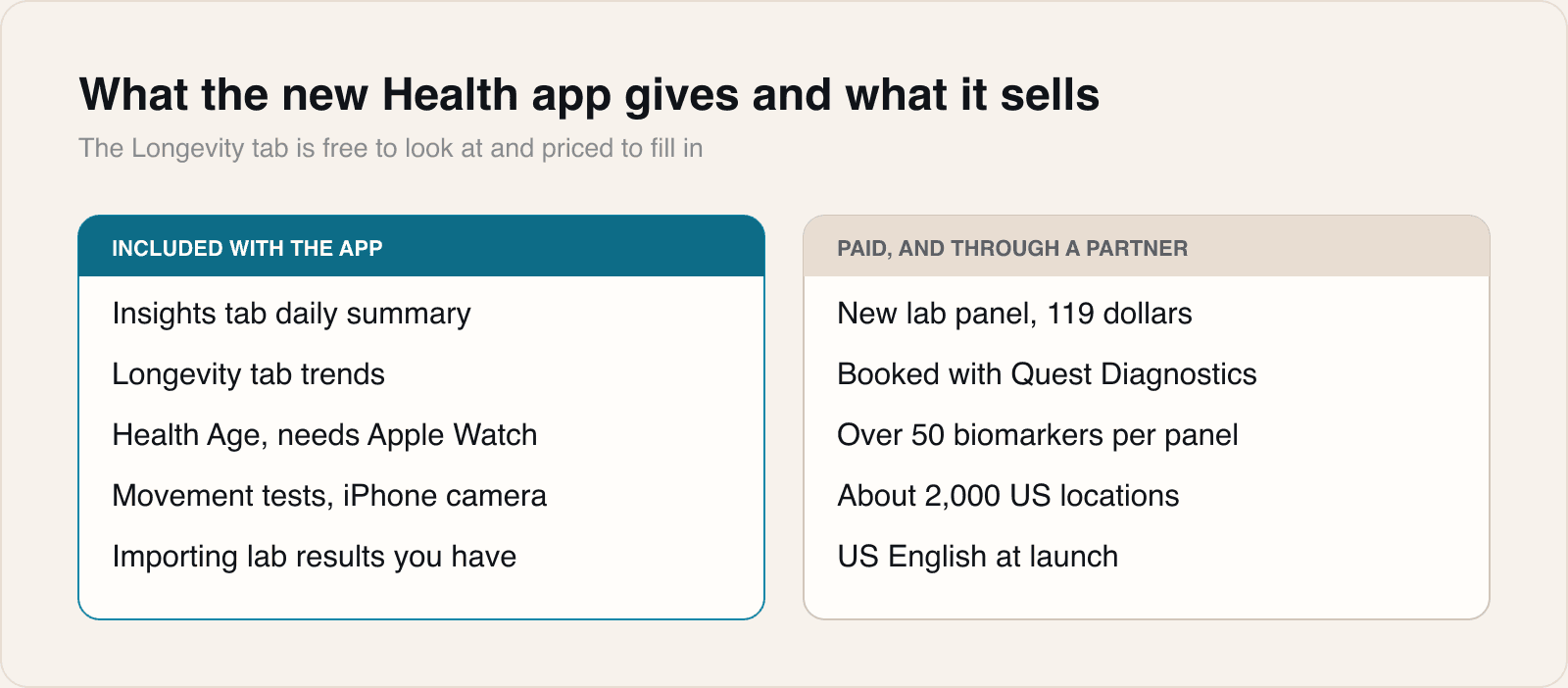
The Longevity tab is where the lab results land. Apple describes it as analysing longitudinal data across heart health, sleep, mental wellbeing, movement, metabolic health, hearing and nutrition, with a visualisation that fills in each category as data arrives. Health Age draws on Apple Watch metrics including VO2 max, resting heart rate, sleep and heart rate variability, and Apple says users can enrich it by adding lab data such as A1c and LDL. Importing lab results a user already has was possible before. Ordering new ones was not.
The requirements are narrower than the release notes suggest. Apple's own footnotes state that the redesigned Health app needs an Apple Intelligence-enabled iPhone or iPad, that it starts in US English with more languages to follow, that Health Age requires an Apple Watch, and that some features require users to be eighteen or older. The Quest arrangement is United States only. Apple names no API and no third-party access of any kind in connection with lab ordering, and we are not going to assume one exists.
Our take
This is the first time Apple has sold a medical service inside Health, and the framing is worth being precise about, because it is not Apple performing a test. Apple is selling a booking. Quest draws the blood, runs the panel and owns the result, and Apple's contribution is the storefront, the payment and the place the numbers land afterwards. That is a narrower role than the Health app's presentation of it implies, and it is also the role with the best margin and the least liability in the whole chain.
What makes it effective as a product is the sequencing, and we mean that as an observation rather than a compliment or a complaint. The Longevity tab is built to show an incomplete picture. Categories fill in as data arrives, so a user with an Apple Watch and no blood work sees a tab that is visibly missing something, in an interface that has already told them this relates to how long they will live. Then the app offers the thing that completes it, for 119 dollars. Nobody had to write a persuasive line of copy. The visualisation does the asking, and it does it every time the tab is opened.
The clinical question underneath is the one Apple's announcement steps around. Broad biomarker panels ordered without a referring doctor are contested in preventive medicine, not because the numbers are wrong but because a panel of fifty markers on a healthy adult reliably produces a few readings outside the reference range, and following those up costs money and anxiety and occasionally leads somewhere harmful. Apple's mitigation appears to be the tailored content it described in September, where a clinician explains on video what an LDL figure means. That is better than a number and a colour, and it is not the same as a doctor who knows the patient. Apple says the algorithms were built with its own physicians and exercise scientists. It has not said what happens when a result comes back abnormal.
For anyone building health software on iOS, the part to watch is not the price. It is that Apple has put a paid service inside a first-party app in a category where third-party apps have to go through App Review and pay commission on anything they sell. Nothing about the Quest arrangement is exposed to other developers, and a competing app offering a comparable booking flow would be subject to rules that do not apply to Health. We would not call that a policy change, because it is not one. It is the existing policy meeting a first-party app that has just started charging, and it is the sort of arrangement that tends to appear in a regulator's filing about eighteen months later.
Sources
 Apple advances health and fitness capabilities using Apple IntelligenceApple Newsroom, 2026-09-09
 Apple releases first iOS 27.2 public beta with new iPhone Health app9to5Mac, 2026-09-22
 Apple Releases First Public Betas of iOS 27.2 and macOS Golden Gate 27.2MacRumors, 2026-09-22
Reporting and images linked above belong to their respective publishers and are shown from their own servers. The analysis here is our own.