
Apple has narrowed Texture and Grain to the iPhone 18 Pro and iPhone Duo, after saying otherwise
Apple has rewritten the footnote on its iPhone 18 Pro announcement so that the new Texture and Grain controls apply only to the iPhone 18 Pro and the iPhone Duo.
Apple has rewritten the compatibility footnote on its iPhone 18 Pro announcement, limiting the new Texture and Grain controls in Photographic Styles to the iPhone 18 Pro, the iPhone 18 Pro Max and three cameras on the unreleased iPhone Duo.
The footnote as it stands on Apple's Newsroom page reads that the controls will be available for photos captured on iPhone 18 Pro models and the Ultra Wide, Main and Center Stage cameras on iPhone Duo. That is a list of named hardware. The version of the same footnote published with the announcement on 9 September was a capability test rather than a list: it said the controls would be available in iOS 27 on iPhone models supporting the latest generation of Photographic Styles, and linked to Apple's support guide for that feature so a reader could check which phones those were. The Internet Archive's copy of the page, captured on 13 September 2026, still carries that earlier wording and that link. The current footnote has dropped the link along with the test.
The distinction matters because the two phrasings describe different sets of phones. MacRumors, which noticed the revision, reports that Apple's iOS 27 User Guide lists the iPhone 16 series, the iPhone 17 series, the iPhone Air and the iPhone 18 Pro models as supporting the latest generation of Photographic Styles. On the original wording every one of those phones qualified for Texture and Grain. On the current wording only the last of them does. MacRumors also found the original text preserved in the copies of the press release distributed to newswires on launch day, which is consistent with the archive.
Which phones are affected
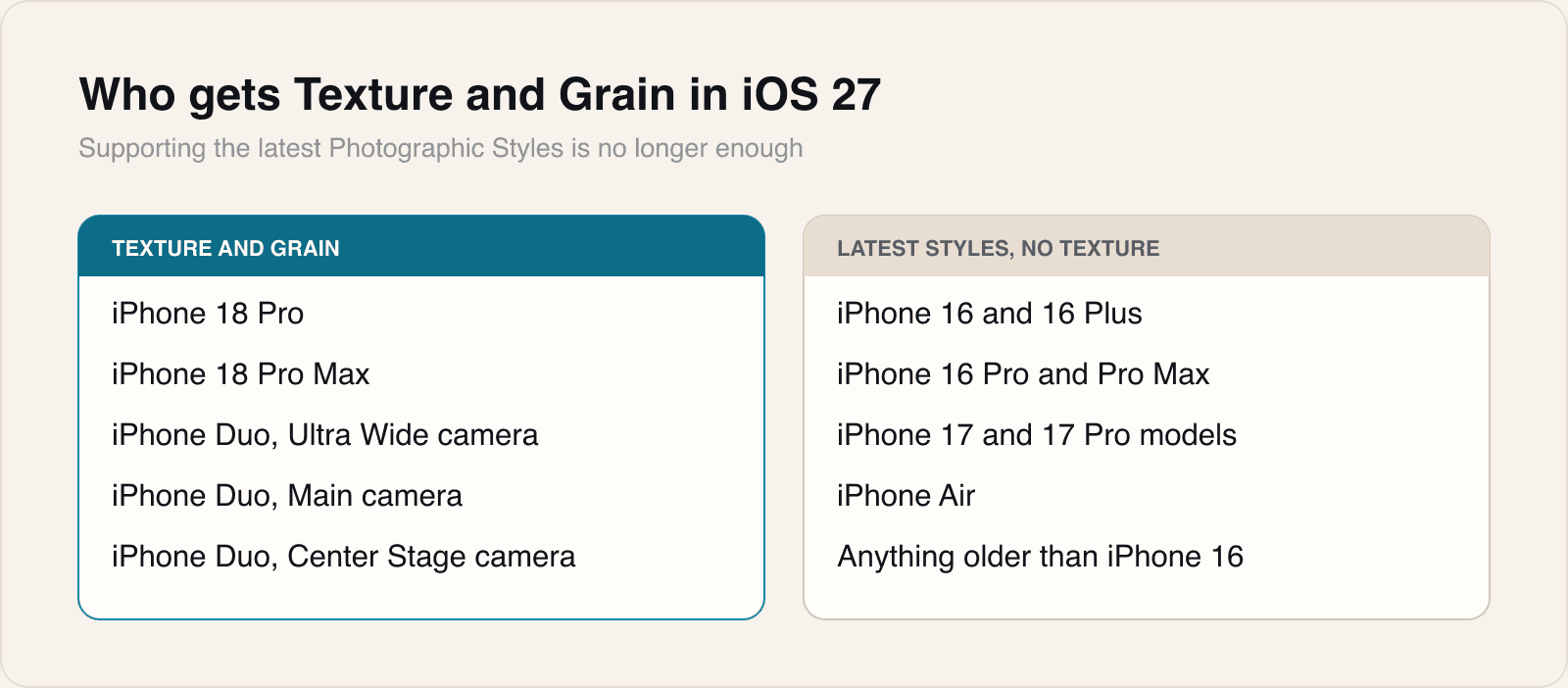
Photographic Styles are tone presets applied at capture, adjusting colour and warmth while attempting to hold skin tones steady. Texture and grain are new controls layered on top of that, letting the appearance be pushed further. Apple has not said whether the revision reflects a change of plan or a mistake in the original copy, and has not commented publicly. What can be established from the sources is only the sequence: one wording on 9 September, still present on 13 September, a different wording by 22 September, no announcement in between.
Our take
Apple gates features on hardware constantly and nobody reasonable objects to that. Sensor read-out, image signal processor capability and neural engine headroom are real constraints, and a control that behaves differently on different silicon is worse than a control that is absent. The problem here is not the gate. It is that Apple published a rule, let the rule stand for a fortnight while people bought phones, then replaced the rule with a list that excludes most of the phones the rule had included, and did it in a footnote with no note saying so.
We are inclined to believe the original was an error rather than a reversal, for a mundane reason: the first wording pointed at a support guide, and pointing at a guide is what you do when you are describing a capability tier that already exists. Someone almost certainly reached for the existing Photographic Styles compatibility line because the new controls sit inside that feature, without checking whether the new controls shared its requirements. That is a plausible mistake. It is also not much comfort to somebody who read the footnote, concluded their iPhone 17 Pro was getting the controls in iOS 27, and now finds it is not.
The wider pattern is worth naming, because this is the second time in two weeks that the checkable detail about a new feature has been in a footnote rather than in the announcement. Live Rewind on the Apple Watch is described in Apple's Series 12 announcement as arriving later this year on two models, a restriction that turns out to govern which Apple Watch gestures everybody else gets to keep. Texture and Grain is described in the body copy of the iPhone 18 Pro announcement with no device qualification at all, and the qualification, the part that determines whether it applies to you, sits in a superscript at the bottom. Footnotes are where compatibility lives now, and they are also apparently where it gets edited.
For anyone writing about Apple features, or building anything that depends on which devices have them, the operational lesson is to treat Apple's marketing footnotes as a snapshot rather than a specification, and to keep an archived copy of the wording you relied on. We only have a checkable account of what changed here because the Internet Archive happened to take a copy four days after launch. The authoritative source for device support remains the support guide and the developer documentation, both of which are versioned and dated in a way a Newsroom footnote is not. Where those disagree with a press release, the press release is the one likely to move.
Sources
 Apple debuts iPhone 18 Pro and iPhone 18 Pro MaxApple, 2026-09-09
 Apple Quietly Excludes Older iPhones From New Camera FeatureMacRumors, 2026-09-22
 Introducing Apple Watch Series 12 with the all-new Health Sensing SystemApple, 2026-09-09
Reporting and images linked above belong to their respective publishers and are shown from their own servers. The analysis here is our own.