Apple patches a CoreGraphics flaw it says was used against targeted individuals
Apple released iOS 26.7.1 on 28 September with a single CVE, a CoreGraphics flaw it says may have been exploited against specific targeted individuals.
Apple released iOS 26.7.1 and iPadOS 26.7.1 on 28 September 2026, patching a CoreGraphics vulnerability the company says may have been exploited against specific targeted individuals.
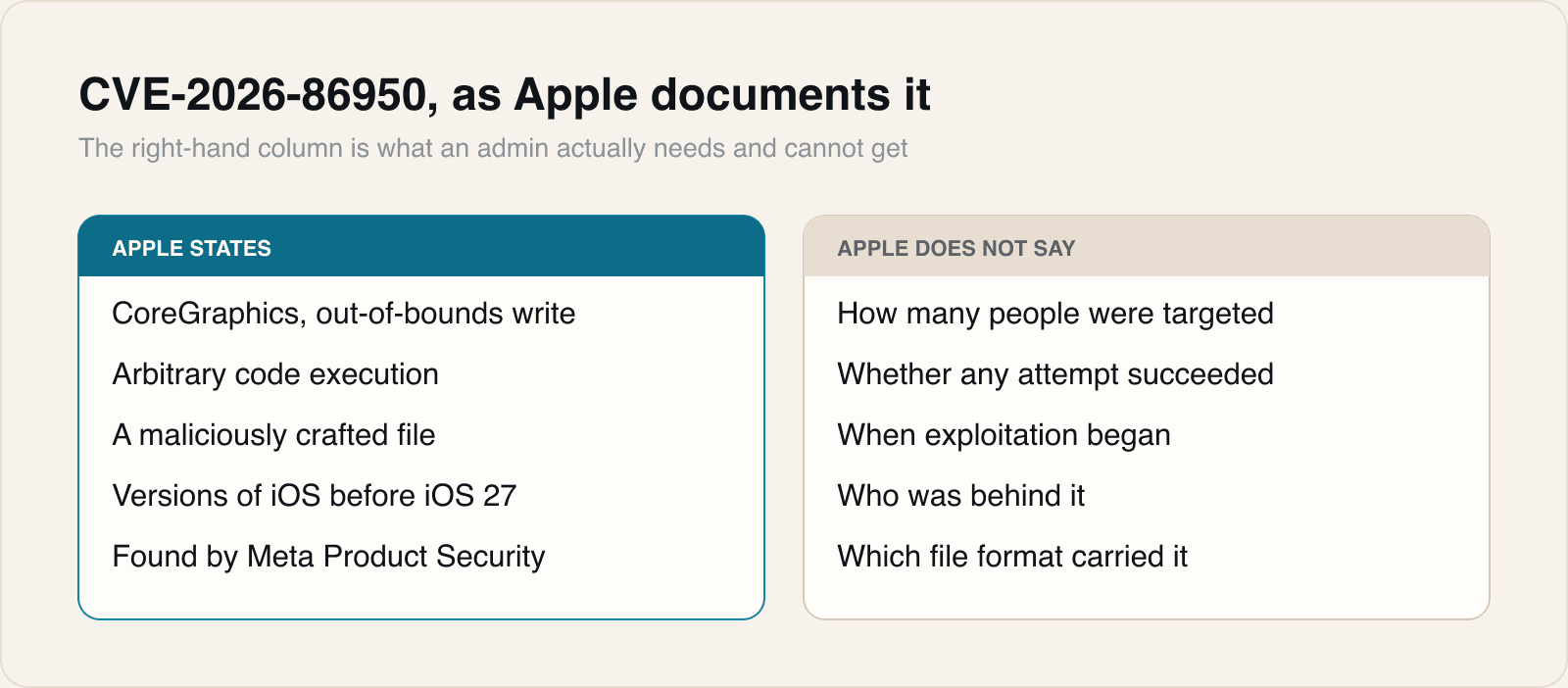
Apple's security content page for the release lists one CVE entry, CVE-2026-86950. It describes an out-of-bounds write in CoreGraphics, and states that processing a maliciously crafted file may lead to arbitrary code execution. The fix is improved bounds checking. The page credits Meta Product Security with finding and reporting it, and confines the exploitation to versions of iOS before iOS 27. The update covers the iPhone 11 and later, the 12.9-inch iPad Pro 3rd generation and later, the 11-inch iPad Pro 1st generation and later, the iPad Air 3rd generation and later, the iPad 8th generation and later, and the iPad mini 5th generation and later.
The same flaw is addressed on the desktop by macOS Tahoe 26.7.1 and macOS Sequoia 15.8.1, released alongside it. The Hacker News notes that Apple gave no figure for how many people were targeted, said nothing about whether any attempt succeeded, and did not date the first observed exploitation. It counts this as the second vulnerability Apple has patched in 2026 after a report of exploitation in the wild, the first being CVE-2026-20700 in February. The 27.0.1 updates that shipped the same day carry no published CVE entries, which is consistent with Apple's statement that the exposure ends before iOS 27.
What Apple has disclosed
What it means
Read the device list before the CVE. This is an update for people who did not move to iOS 27, and the list reaches back to the iPhone 11 and the iPad mini 5 - hardware from 2019, still supported, and disproportionately likely to belong to someone who updates rarely. That is the population an attacker running a targeted campaign would most like to find, and it is the population least likely to read a security page. If you look after a family member's phone or a small office's devices, this is the week to check the ones nobody has touched.
The wording repays attention, because Apple's phrasing here is a form of disclosure rather than boilerplate. It says Apple is aware of a report, not that Apple observed the attacks; it says may have been exploited, not was; and it names the exposure as versions of iOS before iOS 27. Each of those is a limit on what Apple is willing to assert, and together they describe a company patching on someone else's evidence. The credit to Meta Product Security is the other half of that picture. A researcher outside Apple found this, which is the system working, and it also means Apple's account of the attacks is second hand by construction.
CoreGraphics is the part that makes this worth more than a routine patch note. It is the framework that decodes and renders images and documents, it is reachable from almost anything that displays content, and historically it has been the entry point for exactly this class of attack, where a file arrives and no one has to tap anything for it to be parsed. An out-of-bounds write reached through a crafted file, in that framework, on an OS branch a target is likely to be running, is the recognisable shape of surveillance tooling rather than opportunistic crime. Apple has not said that, and we are not attributing it to anyone. We are saying the shape is familiar.
What does it change for people building apps? Nothing in your code, and something in your assumptions. There is no API to adopt and no behaviour to work around; the fix lives below anything an app touches. The assumption worth revisiting is that your minimum supported OS is a compatibility decision. It is also a security decision, because every user you allow to remain on the 26 branch is a user whose protection depends on them installing a point release with no visible features. If your analytics show a meaningful tail on iOS 26, the honest thing is an in-app prompt that says why, rather than a deployment target quietly raised in six months.
The unanswered questions are the ones we would keep an eye on. Nobody knows when exploitation began, which matters because a compromise that predates the patch is not undone by installing it. Nobody has named a file format, so there is no filtering advice anyone can give with a straight face. And nobody has said whether iOS 27 was immune by design or merely by accident of timing, which is the difference between a mitigation Apple built and a window that happened to close. Any of those could be answered later. Until they are, the only action supported by what is actually published is to install the update.
Sources
- About the security content of iOS 26.7.1 and iPadOS 26.7.1Apple Support, 2026-09-28
 Apple Patches CoreGraphics Flaw Possibly Exploited in Targeted AttacksThe Hacker News, 2026-09-28
 iOS 26.7.1 Fixes Vulnerability Used in Targeted AttacksMacRumors, 2026-09-28
- Apple Patches Zero-Day Exploit Alongside September 2026 OS FixesTidBITS, 2026-09-28
Reporting and images linked above belong to their respective publishers and are shown from their own servers. The analysis here is our own.