
A UK tribunal certified a class claim against Apple and Amazon over who could resell on Marketplace
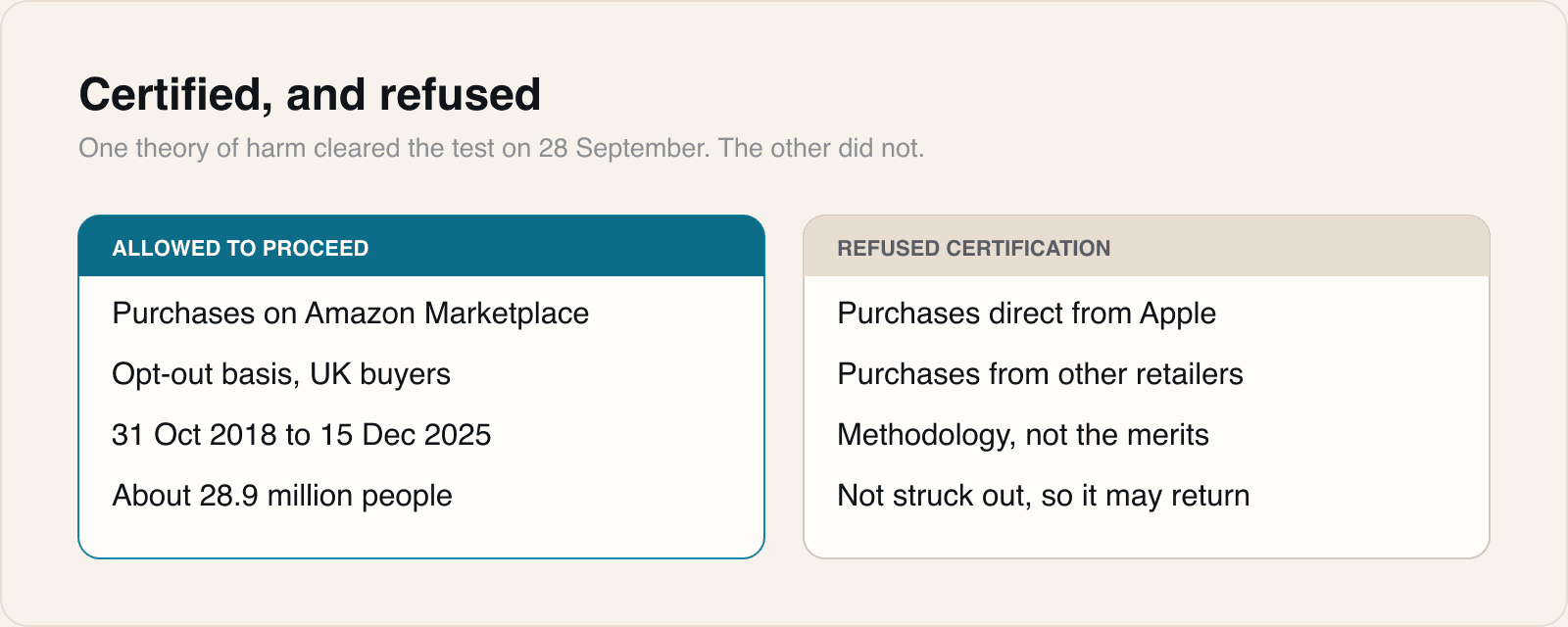
The Competition Appeal Tribunal certified part of a collective claim against Apple and Amazon on 28 September, on an opt-out basis for UK buyers.
Britain's Competition Appeal Tribunal certified part of a collective claim against Apple and Amazon on 28 September 2026, allowing it to proceed to trial.
The claim is brought by JLP A&A Class Representative Limited, with Justin Le Patourel as the proposed class representative. He replaced the consumer law academic Christine Riefa, whose earlier version of the case failed when the tribunal declined to authorise her in that role. The allegation concerns agreements Apple and Amazon entered into in 2018 which, the claim says, unlawfully restricted competition in the sale and advertising of Apple products on Amazon's UK Marketplace by reducing the number of third-party resellers able to operate there, and so raised the prices consumers paid.
Mrs Justice Kelyn Bacon, sitting with two other tribunal members, certified one half of the case and refused the other. The claim covering purchases made through Amazon was found to be, in the tribunal's words, "plausible, credible and grounded in the facts", with a realistic basis for arguing that restrictions on resellers could have increased prices. The wider claim covering products bought directly from Apple or from other retailers was refused, its methodology judged insufficiently coherent and developed to meet the test, though it was not struck out or summarily dismissed.
Certification is on an opt-out basis, which means the people it covers are in it automatically. Solicitor News reports the class as people who bought Apple or Beats branded products at retail level in the UK between 31 October 2018 and 15 December 2025, estimated at around 28.9 million. Reuters, as carried by The Star, puts the value at between 289 and 306 million pounds including interest; AppleInsider rendered the same figure as 383 million dollars. The tribunal attached conditions, including that the funding arrangements strip out costs from the earlier Riefa proceedings, and it capped the class representative's remuneration at 170 pounds an hour with a daily cap of 750 pounds.
Both companies dispute the claim. Apple says the agreement was intended to prevent the sale of counterfeits and that it strongly disagrees with the case; Amazon said it is confident the remaining claim will be shown to be without merit.
What the tribunal decided
What it means
The word doing the most work in every headline about this is certified, and it does not mean what a casual reading suggests. The tribunal has not found that Apple and Amazon did anything wrong. It has found that one of the two theories put to it is coherent enough, and supported by enough evidence, to be tried as a group rather than by 28.9 million people individually. That is a procedural gate, and clearing it says nothing about who wins. We would say that plainly because the alternative framing, which several outlets reached for, turns a case management decision into a verdict.
For a reader in the UK who bought an iPhone in the last seven years, the practical position is: you are probably in the class, there is nothing to do, and nothing is owed to anybody yet. Opt-out is the point of the regime. Claims of this kind exist because the individual loss, a few pounds on a purchase, is far too small for any one person to litigate and the aggregate is not. Nobody needs to register, no deadline has been published, and any message inviting you to sign up to claim your share should be treated with the suspicion that phrasing deserves.
The refused half is the more interesting one. The certified claim covers what people bought on Amazon's Marketplace; the refused claim covered what they bought from Apple directly and from everyone else, which in the UK is most Apple buying there is. The tribunal's reason was methodological, that the model for showing class-wide loss was not developed enough, and it explicitly did not strike the claim out. So the largest part of the case is neither alive nor dead. It can come back with better economics behind it, which means the 289 to 306 million pound figure is a floor on the eventual exposure rather than a ceiling, and it means the next thing worth watching is whether the representative refiles that theory rather than whether the certified one settles.
The substantive question underneath is one that reaches a long way past these two companies. Apple's defence is that the 2018 arrangement existed to keep counterfeit Apple products off Amazon, which is a real problem and a legitimate aim. The claim is that the same arrangement thinned out the reseller field and pushed prices up. Both can be true of one clause. Every brand that runs an authorised reseller programme on a marketplace is in that position, and if this goes to trial the tribunal will have to say something about where anti-counterfeiting control stops and restriction of competition begins. That reasoning, not the money, is what other brands will read.
Two notes on the reporting. The sterling and dollar figures are the same claim converted, not a disagreement, but they are quoted as though they were independent numbers and we have used the sterling one because that is the currency the tribunal is working in. And this case is on the same clock as several other UK proceedings involving Apple, including the encryption order challenge we covered this month. The Competition Appeal Tribunal has become a venue where Apple's commercial arrangements are examined in public, at some length, in a jurisdiction with an opt-out class regime. That is a structural fact about the next few years, and it is more consequential than any single certification decision.
Sources
 Apple Amazon claim partly certified by TribunalSolicitor News, 2026-09-28
 Apple, Amazon face revived UK consumer lawsuit over product salesThe Star, 2026-09-28
 Apple and Amazon face renewed UK antitrust lawsuit9to5Mac, 2026-09-28
 Apple & Amazon UK face revived $383 million price fixing lawsuitAppleInsider, 2026-09-28
Reporting and images linked above belong to their respective publishers and are shown from their own servers. The analysis here is our own.