
iOS 27.0.1 fixes the Face ID restart, and names two more iPhone 18 Pro faults
Apple released iOS 27.0.1 on 28 September, fixing the bug that made an iPhone 18 Pro restart when a Face ID scan failed, plus two others.
Apple released iOS 27.0.1 on 28 September 2026, two weeks after iOS 27 itself, and its release notes name the Face ID fault that had been restarting iPhone 18 Pro handsets.
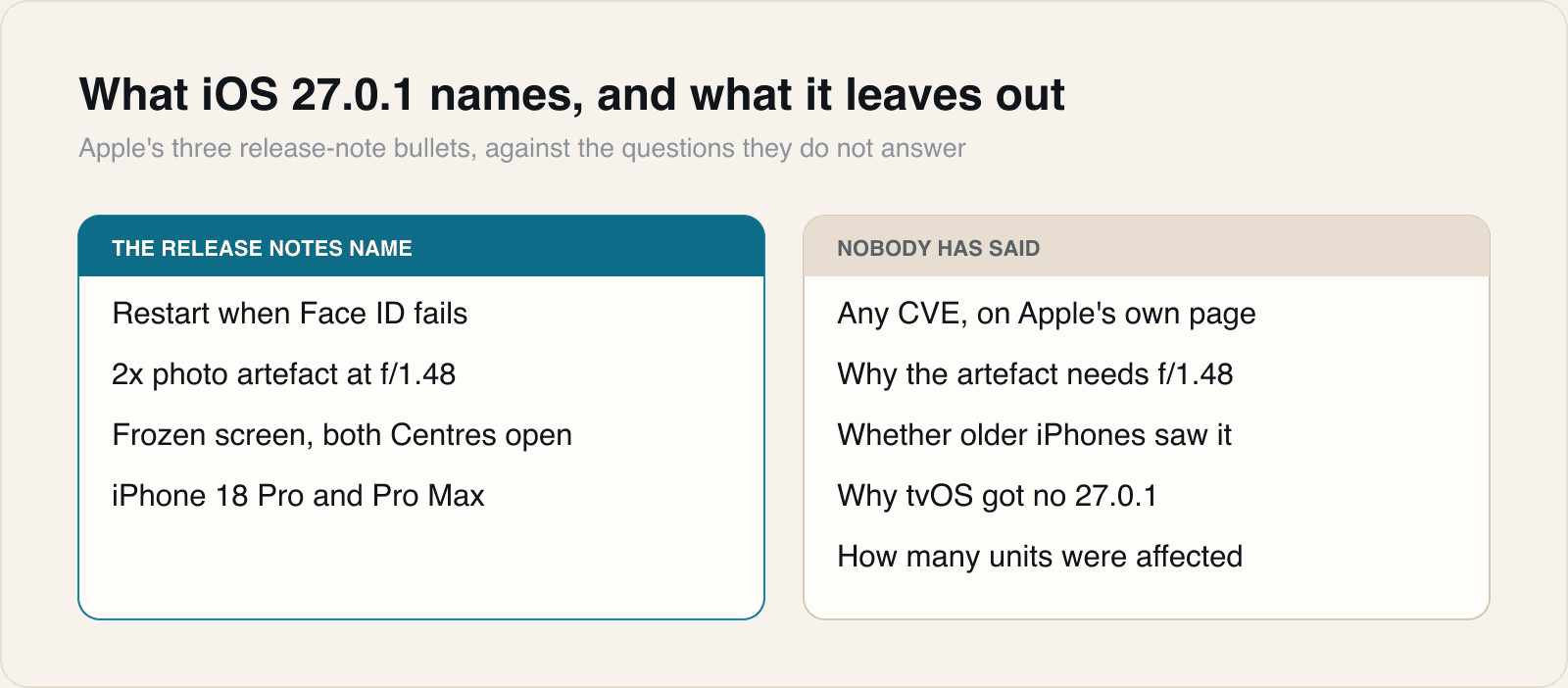
The notes list three fixes. The first is that an iPhone 18 Pro or iPhone 18 Pro Max may restart unexpectedly when Face ID fails to authenticate. The second is a colour artefact appearing on photographs captured at 2x in certain lighting, which 9to5Mac's rendering of the note pins to the f/1.48 aperture setting on a small number of Pro and Pro Max units. The third affects any iPhone on iOS 27: opening Notification Centre and Control Centre at the same time could leave the touchscreen unresponsive. The update arrives over the air at Settings, then General, then Software Update. AppleInsider gives the iOS build as 24A446.
It did not ship alone. iPadOS 27.0.1, macOS Golden Gate 27.0.1 and visionOS 27.0.1 went out the same day, and watchOS 27.0.1 was extended to the rest of the Apple Watch line. That watch update first appeared on 23 September for the Series 12 and Ultra 4 only; 9to5Mac reports that the same build, 24R365, now reaches the SE 3, Series 9, 10 and 11, and the Ultra 2 and Ultra 3. tvOS received no 27.0.1 at all. None of the 27.0.1 updates carries a published CVE entry on Apple's security releases page, which is where the round splits from the older branch: the 26.7.1 updates released the same day patch a flaw Apple says was used against targeted individuals.
What the notes say, and what they do not
Our take
We reported the Face ID fault on 24 September, when 9to5Mac could reproduce it on demand and Apple had confirmed a fix was coming. The useful thing now is not that the fix exists but that Apple described the bug in its own words, in a document every affected owner reads. A failed Face ID scan restarting the phone is an embarrassing sentence to publish about a two-week-old flagship, and publishing it is the right call: the alternative, a notes entry reading improves stability, would have left thousands of people unsure whether the thing that happened to them had been fixed.
The second bullet is the one we would read twice. A colour artefact that appears at 2x, in certain lighting, at f/1.48, on a small number of units is an unusually specific set of conditions, and f/1.48 is not a setting a person chooses. It is one stop of the variable aperture Apple introduced on this generation, selected by the camera system rather than by the photographer. That places the fault at the intersection of a new mechanical part and the image pipeline that compensates for it, and it means an owner could have been getting the artefact for a fortnight without ever knowing which control produced it. Apple has not said whether the correction is to the aperture's behaviour or to the processing downstream, and the difference matters to anyone who has already taken the photographs.
The third fix deserves more attention than it will get, because it is the only one that touches every iPhone on iOS 27 rather than the new Pro models. An unresponsive touchscreen is the most alarming failure mode a phone has - there is nothing to try, no error, and no obvious way to tell a software fault from a broken digitiser. The trigger, opening both Centres at once, is the kind of gesture collision that a person discovers by accident and cannot reliably repeat, which is precisely why it survived the beta cycle. If you had a frozen screen on iOS 27 and wrote it off as a one-off, this is the note that explains it.
For anyone shipping an app, the practical item is the absence of a CVE rather than the presence of a fix. A point release with no security content is one you can adopt in a test matrix without treating it as urgent, and one you cannot use to argue a user must update. The people who genuinely must update today are on the 26 branch, not this one. We would also not read anything into visionOS 27.0.1's notes mentioning security fixes while its security page lists no CVEs. That mismatch is worth noting and not worth theorising about; Apple publishes CVE entries late often enough that the honest position is to wait.
The watch detail is the quiet one. Apple shipped 24R365 to two models on 23 September for a restart bug whose panic logs pointed at the Neural Engine, and has now shipped the identical build to seven more models that were never described as affected. Either the fault reached further than the original device list implied, or Apple has decided the fix is worth having everywhere. Nothing in the release notes distinguishes the two, and we would rather say that than guess which it is.
Sources
 Apple Releases iOS 27.0.1 With Face ID Bug FixMacRumors, 2026-09-28
 Apple releases iOS 27.0.1 for iPhone, here's what's new9to5Mac, 2026-09-28
 First urgent bug fixes arrive for macOS 27, iOS 27, iPadOS 27 and moreAppleInsider, 2026-09-28
 watchOS 27.0.1 is now available for all compatible Apple Watch models9to5Mac, 2026-09-28
- Apple security releasesApple Support, 2026-09-28
Reporting and images linked above belong to their respective publishers and are shown from their own servers. The analysis here is our own.