
Emergency SOS via satellite reaches Norway, and Apple's own caution names northern Norway
Apple added Norway to Emergency SOS via satellite on 29 September, in a support document updated the same day.
Emergency SOS via satellite is now available in Norway, according to an Apple support document updated on 29 September 2026.
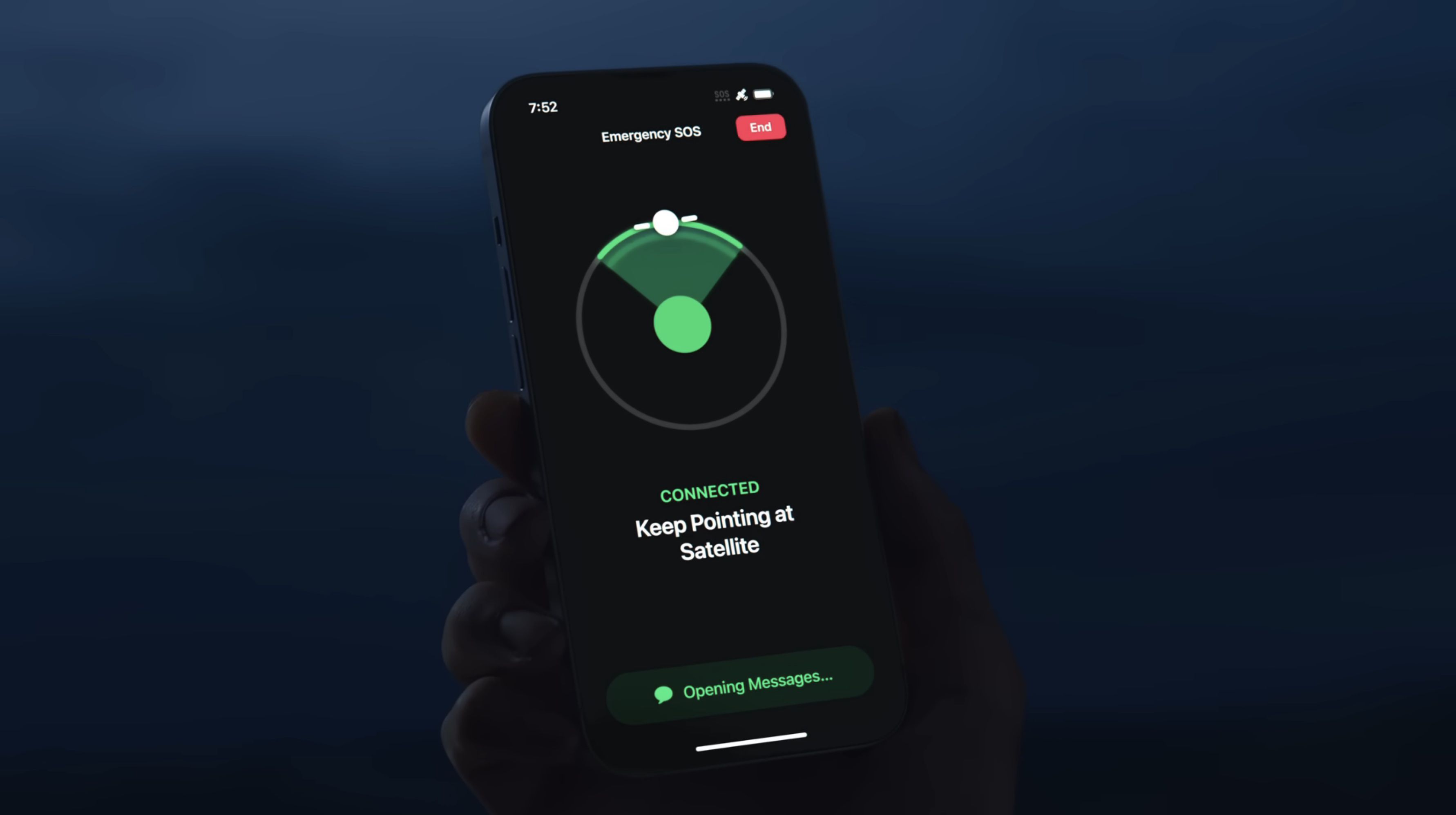
Apple's availability page lists Norway alongside Andorra and Iceland as the three countries requiring iOS 26.4 or later, rather than the older builds that cover the rest of the list. MacRumors adds that the feature needs watchOS 26.4 or later on the watch side, and that it runs on iPhone 14 and later across all models and on Apple Watch Ultra 3 and newer. The emergency number Apple names for Norway is 112. The service lets a person text emergency services from somewhere with no cellular and no Wi-Fi coverage, and Apple's page says it is free for two years after an iPhone 14 or later is activated.
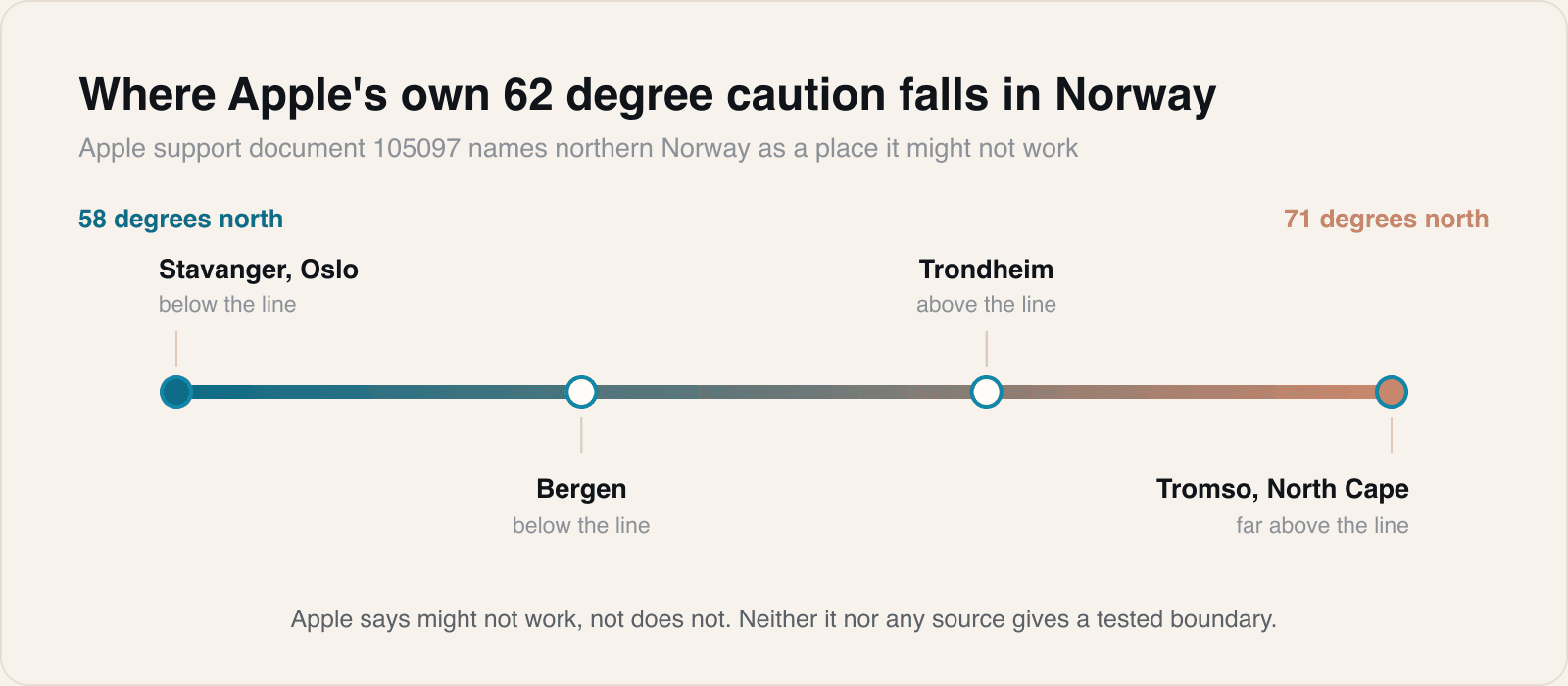
The document is unusually frank about where it stops working. Apple's page on connecting to a satellite states that satellite connectivity might not work in places above 62 degrees latitude, and gives two examples: northern parts of Alaska, and northern parts of Norway. The same page warns that sending a message can take 30 seconds or more in ideal conditions with a clear view of the sky, and several minutes under foliage or in higher latitude regions. Apple also documents that once connected, the phone shares Medical ID, emergency contacts, location including elevation, and remaining battery life.
What happens above the line?
Our take
Apple has launched a wilderness safety feature in a country whose wilderness is mostly north of the point where its own documentation stops promising the feature works. Trondheim, Norway's third largest city, sits above 63 degrees north. So does every fjord, plateau and national park above it, and so does the entire Arctic portion of the country, which is precisely the terrain where somebody is off the grid with a broken ankle and no signal. Oslo, Bergen and Stavanger are all south of the line, and they are also the places where you can generally just ring 112.
We should be careful about how hard to push this, because Apple's wording is careful too. It says might not work, not does not work, and it names northern parts rather than drawing a border. Neither Apple nor any source we can find publishes a tested boundary, a success rate by latitude, or what degradation actually looks like in practice: a slower connection, an intermittent one, or none at all. APPDOOK would rather state that gap than fill it, and it is a real gap, because the difference between slow and absent is the whole question for anyone deciding what to carry.
There is a second thing in the primary source that nobody has picked up. Apple's page says a message goes either to emergency service providers directly or to its Emergency Relay Center, which then reports the content onward. It then lists the languages the relay centre supports: English, Canadian French, Dutch, French, German, Italian, Japanese, Portuguese and Spanish. Norwegian is not among them, and neither is Icelandic, for the country added in the same round. Apple does not say which of the two routes a Norwegian message takes, so we are not going to claim this is a problem. We are going to say it is an obvious question, that the answer is not published anywhere we can find, and that for a safety feature it should be.
What it means if you build for the outdoors
There is no API here, and Apple names none, so nothing changes in anyone's code today. What changes is a claim you can no longer make safely. Any hiking, sailing, climbing or expedition app that describes satellite SOS as a backstop is now describing something Apple itself hedges for a large share of the country it just launched in. If your app has Norwegian users, the responsible copy says what Apple's document says rather than what the marketing implies, and a route planner that knows a trip goes north of 62 degrees has a genuine reason to mention it.
For everyone else, the practical reading is narrower and still worth having. Crash Detection and Fall Detection can escalate over satellite when there is no other coverage, which means this quietly upgrades a car accident on an empty Norwegian road as much as it does a mountaineering emergency. Those roads are mostly in the south. On the published facts, that may be where this feature does its most reliable work, which is not where anybody would have guessed.
Sources
 Apple Says Emergency SOS via Satellite Now Available in NorwayMacRumors, 2026-09-29
- Use Emergency SOS via satellite on your iPhoneApple Support, 2026-09-29
- Connect your iPhone to a satelliteApple Support, 2026-09-29
Reporting and images linked above belong to their respective publishers and are shown from their own servers. The analysis here is our own.