
Meta's Muse Spark Open is an 816 billion parameter model built to run across M5 Ultra Mac Studios
Meta has released the weights of Muse Spark Open, an 816 billion parameter model it tuned with Apple's MLX to run across two or more M5 Ultra Mac Studios.
Meta released the weights of Muse Spark Open, a large open AI model, on 15 October, and says it is optimised to run on Mac Studios with the M5 Ultra chip.
According to Meta's announcement, the model has 816 billion parameters in total, of which 42 billion are active for each token, because it is a mixture-of-experts design that only wakes part of itself at a time. It is natively multimodal, has a context window of one million tokens, and is aimed at coding and agent work. Meta calls it the "most capable US open-weight model to date". The weights are on Hugging Face in two forms, the full BF16 version and a compressed NVFP4 version, and on Amazon SageMaker, Google Cloud and Microsoft Foundry. They come under a Muse Model License that Meta describes as having limited commercial terms; the announcement does not spell out where those limits fall.
The release is a change of course. Muse Spark, the model Meta launched in April from its Superintelligence Labs, was kept closed, with Alexandr Wang, Meta's chief AI officer, saying later versions could be opened. This is the first open one.
What Apple published alongside it
Apple's Machine Learning Research team posted its own account the same day, describing how MLX, Apple's open-source machine learning framework for Apple silicon, runs very large models on one or several Mac Studios. Meta says Muse Spark Open was tuned for the latest MLX release, and the mlx-lm package can load it straight from Hugging Face.
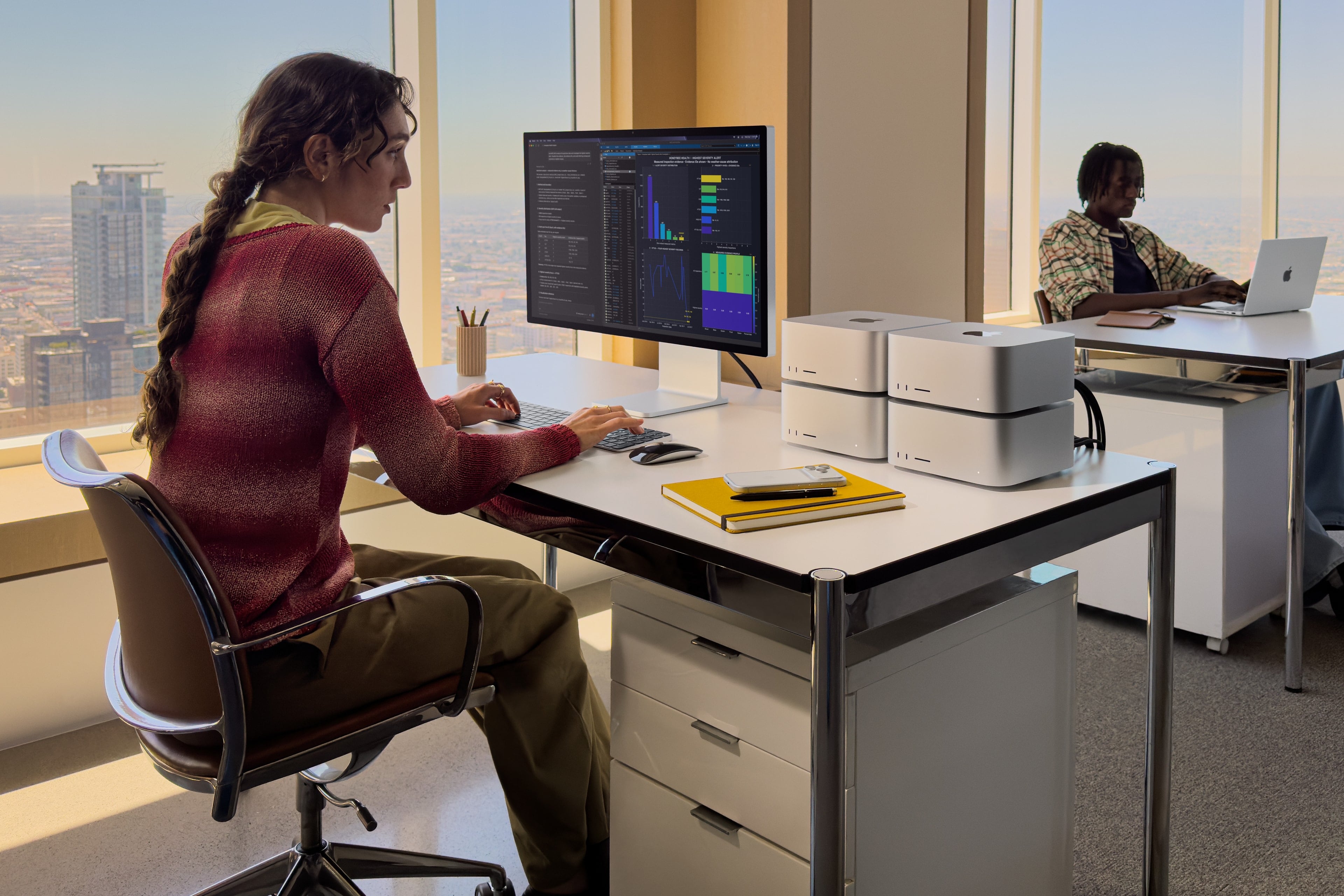
Apple's numbers set out what the model needs. In BF16 it takes more than 1.6TB of memory. In NVFP4 it takes about 493GB, which Apple says is still too large for one machine once working memory is counted, so the smallest setup is two Mac Studios. The machines are linked over Thunderbolt 5 using RDMA, a way for one computer to read another's memory directly, which arrived as a driver in macOS 26.2; MLX 0.30.1 and later supports it. Apple tested one, two and four machines, with two Thunderbolt cables per link.
Apple's measurement | Result |
|---|---|
M5 Ultra against M3 Ultra, time to first token | up to 4.6 times faster |
M5 Ultra against M3 Ultra, generation speed | 1.6 times faster |
Two machines against one, 65,536-token prompt | about 1.8 times faster to start |
Muse Spark Open on four M5 Ultras | 36.73 tokens a second |
Peak power per M5 Ultra during inference | about 300W |
Splitting the model across two machines speeds up reading a long prompt but, by Apple's figures, leaves generation speed essentially unchanged. Apple credits most of the gain over the M3 Ultra to the Neural Accelerators in the M5 family's graphics cores.
Which Mac Studio runs Muse Spark Open?
Only the top one. Apple's specification page shows the 512GB memory option is available only with the 36-core CPU and 80-core GPU M5 Ultra, which has 1.2TB/s of memory bandwidth and six Thunderbolt 5 ports. Meta's own pitch is that two such machines behave like one computer with about a terabyte of memory. Apple has not published a price for the 512GB configuration; MacStories reports that it is due at the end of the year, and notes that a 256GB M5 Ultra with 2TB of storage already costs more than $11,000. The M5 Ultra Mac Studio starts at $5,499 with 96GB.
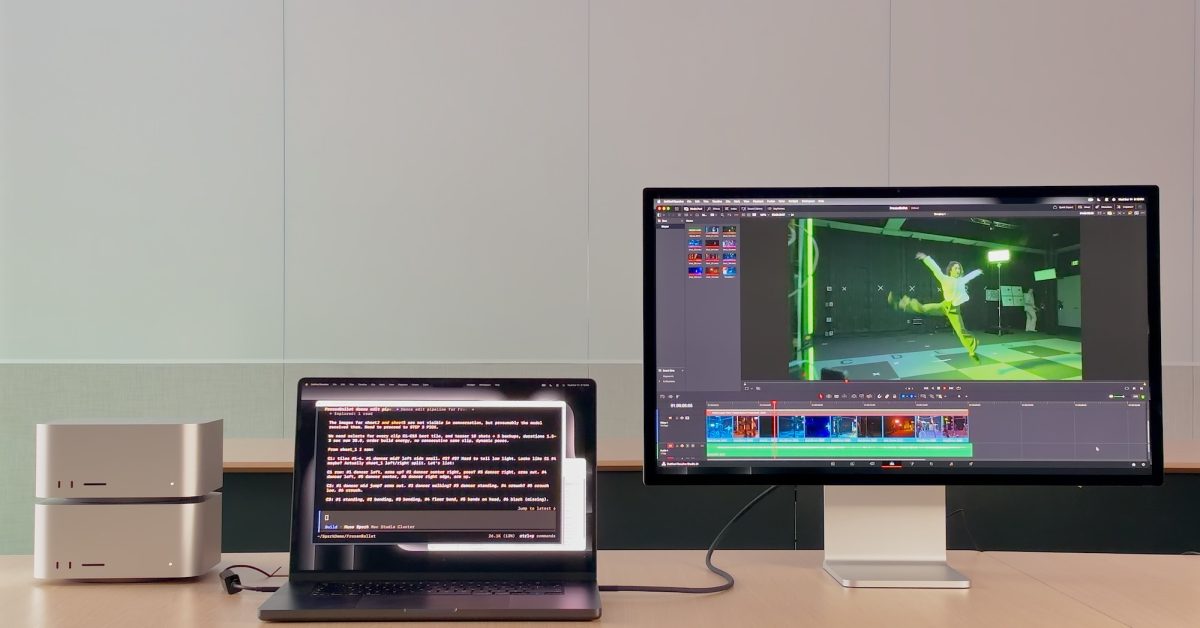
Meta says it tested agent work running entirely on the Macs with Muse Code, its coding tool, including bug fixes, new features and a full build of the iOS version of Ice Cubes, an open-source Mastodon app, and editing in DaVinci Resolve. Wang told Axios, as 9to5Mac reports it, that Apple and Meta had worked together for several months, and credited Daniel Gross, a former Apple executive, with bringing the two together. Neither company has announced a formal partnership.
Our take
For Apple, this is a better advertisement than any keynote slide. A leading AI lab chose the Mac Studio as the desktop it names for a frontier-sized open model, and Apple put its own engineers' benchmarks next to the release on the same day. What APPDOOK finds more significant is the plumbing rather than the model: RDMA over Thunderbolt 5 and multi-machine MLX are what turn a stack of Mac Studios into something that holds a model this size, and anything else that is too big for one Mac benefits the same way.
Nobody should read this as a model for home. Two 512GB machines at a price Apple has not set, very likely well into five figures for the pair, is only the entry point, and Apple's 36 tokens a second came from four of them. That is a lab, a studio or a company keeping its code off other people's servers, not a hobbyist. For most people running models locally the sensible machine is still smaller: one reviewer of the M5 Max Mac Studio ran a 120 billion parameter model on it at about 75 tokens a second, and another judged the Max the better buy than the Ultra for most desks.
For app makers the interesting demo is the least glamorous one. An agent that fixed bugs and completed a full build of an iOS app without the code leaving the building is exactly what teams under client confidentiality have wanted, and the Muse Model License is the thing to read first, because Meta has not said where its commercial limits sit. We would also wait for Meta's evaluation report, which it says is coming, before trusting its benchmark claims on Swift work in particular.
What is still unknown: the price of the 512GB Mac Studio, whether Apple ever ships one machine big enough for the compressed model alone, and how smaller distilled versions might fit on ordinary Macs, which Meta has not mentioned. Open weights spread to whatever hardware people own, as ToshLLM's local models on old Intel Mac Pros showed last week, so the community conversions will probably say more about everyday Macs than Meta's launch does.
Sources
 Muse Spark OpenMeta, 2026-10-15
 Local and Distributed Large LLM Inference with MLX and RDMA on Mac StudioApple Machine Learning Research, 2026-10-15
 Muse Spark Open collectionHugging Face, 2026-10-15
- Meta debuts Muse Spark, first AI model under Alexandr WangAxios, 2026-04-08
 Mac Studio - Technical SpecificationsApple, 2026-10-15
 Meta launches new Muse Spark Open model, optimized to run on Mac Studio9to5Mac, 2026-10-15
 Meta Releases Muse Spark Open, an Over 800 Billion Parameter Model That Can Run Locally on Multiple M5 Ultra Mac StudiosMacStories, John Voorhees, 2026-10-15
Reporting and images linked above belong to their respective publishers and are shown from their own servers. The analysis here is our own.
How we report: editorial policy. Spotted an error? Report a correction.
Newsletter
Apple news, in your inbox
Get APPDOOK's Apple news by email, checked against the source like everything here.
Follow APPDOOK
New Apple stories every day, checked against Apple’s own sources.